Workshops set the tone for 2026 Annual Conference
By: Alison Burdett in collaboration with several workshop attendees
As the 242nd Session of the Baltimore-Washington Conference opened Wednesday morning, annual conference members gathered across the Hilton in Baltimore for a wide range of workshops designed to deepen discipleship, strengthen leadership and encourage faithful engagement with the challenges facing the church and world today. Centered around the conference theme, “Rooted in Christ: Love Boldly,” the workshops invited participants into conversations on justice, spiritual formation, congregational vitality, history, technology and adaptive leadership.
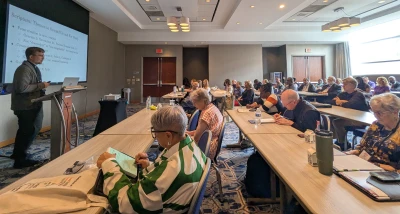 One of the most heavily attended workshops was “Benefits and Risks of Artificial Intelligence,” led by Rev. David Jacobson and Rev. Mark Gorman. The session emerged from a conference-wide task force formed after the passage of a 2025 resolution, Encouraging Awareness and Faithful Living in the Era of Artificial Intelligence, encouraging churches to discern faithful living in the era of AI. Jacobson, who holds a master’s degree in computer science, walked participants through the rapidly changing landscape of artificial intelligence, explaining how systems like ChatGPT and Claude are evolving beyond simple prediction models into increasingly powerful “agentic systems” capable of sustained planning and complex tasks. He highlighted both the promise and peril of the technology, from productivity gains and medical breakthroughs to environmental concerns, misinformation, job displacement and ethical questions surrounding human agency.
Gorman grounded the conversation in Scripture, Wesleyan theology and the church’s Social Principles, urging participants not to respond out of fear or hype, but through communal discernment rooted in prayer. The workshop sparked lively table discussions as attendees wrestled with questions about creativity, justice, labor and the image of God in an increasingly technological world. Participants reflected on whether AI could serve humanity faithfully or whether overreliance on technology risks diminishing uniquely human gifts and relationships.
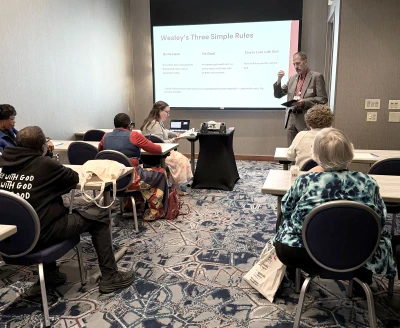 In “A Journey Toward Christian Love: John Wesley’s General Rule of Discipleship in Action,” members of the Congregational Vitality team explored how churches can move beyond membership models toward intentional discipleship pathways. Bill Brown, Lauren Jones, TJ Mount, Bessie Hamilton and Abby Butler-Cefalo guided participants through Wesley’s principles of “do no harm, do good, and stay in love with God,” encouraging congregations to empower members to engage in acts of compassion, justice, worship and devotion. The team also shared plans for a new discipleship resource that will launch this fall to help churches strengthen spiritual formation and congregational vitality.
Another workshop, “Love Boldly and Risk Greatly: Faithful Responses to the Current Immigration Realities in the U.S.,” challenged attendees to consider how churches can faithfully accompany immigrant communities facing increasing fear and uncertainty. Led by Rev. Cassy Núñez and Rev. Carlos Reyes Rodríguez, the session examined recent immigration policy changes and their impact on families and congregations. Drawing on the biblical story of the Hebrew midwives Shiphrah and Puah, the leaders emphasized courage, allyship and the church’s baptismal commitment to resist “evil, injustice and oppression.” Participants were encouraged to develop practical safety plans and discern how their congregations can provide advocacy, hospitality and tangible support for immigrant neighbors.
Rev. Kendal L. McBroom, Director of Civil and Human Rights for the General Board of Church and Society, led the workshop “Strength for Today, Bright Hope for Tomorrow: Equipping Leaders to Love Boldly Through the Social Principles.” McBroom reminded participants that the Social Principles provide moral grounding for navigating today’s public challenges while remaining rooted in Wesley’s understanding of “social holiness.” The workshop encouraged leaders to balance personal piety with works of mercy and justice, offering practical ways to engage difficult issues with courage, compassion and hope in God’s sustaining grace.
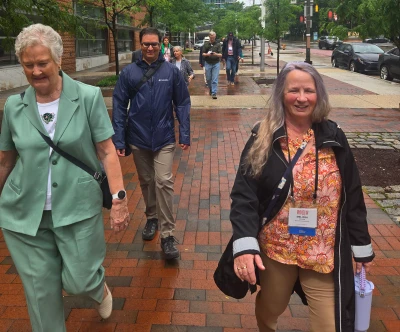 Meanwhile, participants in the “Methodist Community Roots Walking Pilgrimage” experienced Baltimore’s Methodist history firsthand. Although thunderstorms forced a change in plans, the pilgrims embraced the spirit of the journey, beginning with a discussion on the theology of pilgrimage and the history of Methodism in Baltimore before venturing through the city. Stops included the site of the first Sharp Street Congregation, known as the Mother Church of Black Methodism, the harbor area and Old Otterbein Church, where participants visited the grave of Bishop Philip Otterbein and reflected on the roots of the United Brethren tradition within United Methodism.
Other Wednesday workshops explored adaptive leadership, emotional and spiritual wellness, innovative ministry practices and practical tools for strengthening congregational life in uncertain times. Together, the workshops set the tone for the opening day of Annual Conference: thoughtful, hopeful and deeply committed to equipping United Methodists to lead faithfully in a rapidly changing world.
Workshop PPT slides are being added to this story as they become available.
- Benefits and Risks of Artificial Intelligence - PPT with Notes
- Love boldly and risk greatly: Faithful responses to the current immigration realities in the U.S - PPT