UMCOR Grant Supports Long-Term Flood Recovery in Allegany County
By Alison Burdett
Interim Director of Communications
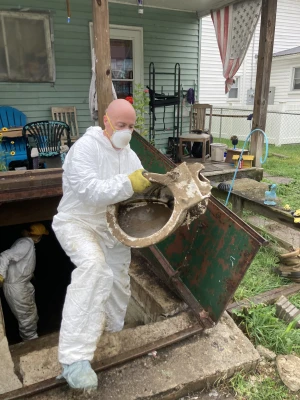 When floodwaters surged through parts of Allegany County, MD, in May 2025, some residents' homes were flooded with four feet of water, damaging furnaces, furniture, and other property. Schools closed for weeks, businesses shuttered, and entire neighborhoods in Westernport and Lonaconing were left reeling.
Nine months later, recovery is still underway, and United Methodists are committed to walking alongside survivors for the long haul.
Recovery Director Thea Becton said that while the immediate response phase ended months ago, long-term recovery in Allegany County is still ongoing and could take years.
“Based on the formula that’s used during recovery, this particular effort is likely to take three years,” Becton said.
The flooding, caused by heavy rains and the overflow of Georges Creek, was not federally declared a disaster, so FEMA assistance was not available. That reality placed the entire recovery effort on state and local governments and faith-based partners.
Through its role as a local UMCOR affiliate, the Baltimore–Washington Conference mobilized quickly. In the immediate aftermath, the Conference received a $10,000 UMCOR solidarity grant. Those funds paid for the immediate need for gift cards for survivors and for data-collection software, which was essential to protect clients' identities.
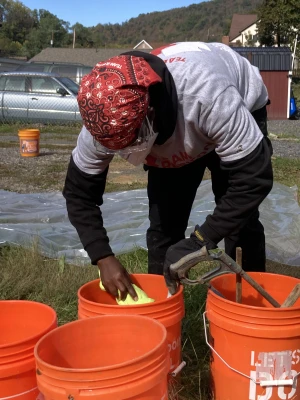
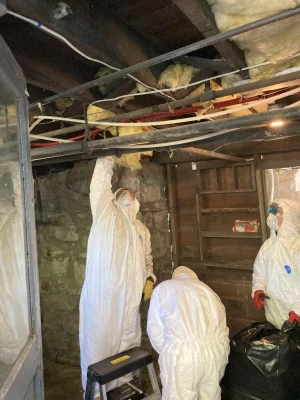
Disaster response teams worked through Maryland VOAD (Voluntary Organizations Active in Disaster) to distribute water, gift cards, and more than 3,500 cleaning buckets and hygiene kits, while also conducting initial damage assessments and community canvassing. United Methodist volunteers were joined by partners from across Maryland and neighboring West Virginia to assist with mucking, gutting, and debris removal.
“Because we already had supplies staged in our disaster hubs, we were able to respond within two weeks,” Becton said. “That kind of preparedness makes a real difference.”
 In the fall, the Disaster Response team applied for and was given a $200,000 UMCOR recovery grant. Those funds support transition from early response to long-term recovery.
The recovery grant supports staffing, including Becton’s role, a program manager, and three disaster case managers, as well as equipment, construction supplies, and direct assistance for survivors. More than half of the UMCOR recovery grant is designated for direct aid to affected households.
“The grant allowed us to respond more comprehensively and equitably than we could have on our own,” Becton said. “Our primary focus of the grant is ensuring resources are distributed fairly to survivors.”
In partnership with the Maryland Office of Emergency Management, Allegany County Department of Social Services, MD Department of Housing & Community Development, Lutheran Disaster Response, and other VOAD partners, nearly $1 million has already been distributed directly to survivors, not for overhead or staffing, but for urgent, tangible needs.
That assistance has included mold remediation, replacement of furnaces, washers, and dryers, and other essential repairs. As winter temperatures plunged well below zero, restoring heat became a top priority.
“Some families are back in their homes but still living without heat or hot water,” Becton said. “In the meantime, community partners have stepped in with space heaters and heated blankets while we continue case management.”
 To date, disaster case managers have engaged with 215 families, with an estimated 450 to 475 households expected to need assistance as recovery continues.
One couple Becton described has been displaced from their home for nine months after floodwaters destroyed their basement, furnace, and belongings, and they are living with their children. Their 19th-century home, built of stone and brick, presents unique challenges and higher repair costs. Recovery plans now include not only repairs, but accessibility upgrades so the couple can live safely as they age.
“Some losses can’t be restored,” Becton said. “Part of our work is helping people face that reality without being retraumatized, and reminding them they’re not alone.”
That work, she says, is deeply rooted in faith.
“I really believe that God will give us beauty for ashes,” Becton said. “Even when things are out of order, I have the privilege of walking with people on that journey.”
Becton sees long-term disaster recovery as a clear expression of United Methodist theology.
“Our ministries of mercy and justice are central to who we are,” she said. “Justice means ensuring everyone has equitable access to resources, that people are treated respectfully, and that their dignity is maintained.”
Recovery in Allegany County is expected to take about three years, with volunteers and local leaders continuing to meet weekly as part of a long-term recovery group.
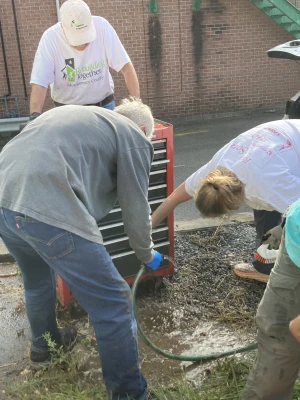 “There is a true sense of community here,” Becton said. “People continue to give, to show up, and to do whatever is needed so their neighbors can recover well.”
Becton encourages United Methodists across the Conference to remember two things: disasters can happen anywhere, and everyone has a role to play.
“Preparedness for your family and your place of worship is essential,” she said, pointing to Ready.gov as a helpful resource.
And when it comes to response, she says, service takes many forms.
“Our youngest volunteer packing flood buckets and hygiene kits was nine. Our oldest was 91,” Becton said. “Not everyone has to be boots on the ground. Sometimes it’s a phone call, a card, or a meal. The ministry of presence matters. Spiritual and emotional care can be provided by lay and clergy alike.”
Those interested in serving or learning more can contact Thea Becton at .