Seven United Methodist Bishops Led Historic Good Friday Service in Hanover
By Alison Burdett
Director of Communications
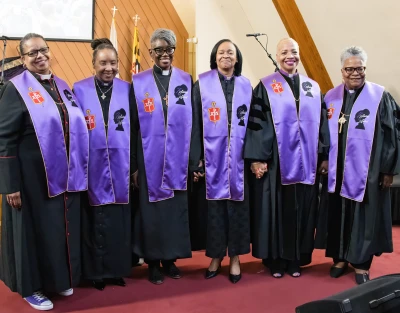 In a historic and sacred Good Friday service, all seven active African American female bishops of The United Methodist Church gathered at St. Mark United Methodist Church in Hanover, Maryland, to proclaim the Seven Last Words of Christ, marking a radical moment in the life of the denomination and the fulfillment of a vision years in the making.
The 15th anniversary of The Seven Last Words Featuring Seven Sisters of the Spirit, founded by the Rev. Jason Jordan-Griffin, took place April 3 and brought together these episcopal leaders in a service centered on Christ’s final words from the cross, with each bishop connecting the suffering on Calvary to the realities of today’s world. Jordan-Griffin described the moment as a “divine crescendo,” rooted in a promise he made as an undergraduate at Boston University after witnessing an all-women Good Friday service. “I vowed that if God ever entrusted me with pastoral leadership, I would create intentional space for the prophetic voices of women to be heard with power during Holy Week,” he said.
The service featured:
- Bishop Cynthia Moore-Koikoi preaching on “Father, forgive them; for they know not what they do.”
- Bishop Robin Dease preaching on “Today you will be with me in paradise.”
- Bishop Kennetha J. Bigham-Tsai preaching on “Woman, behold your son. Son, behold your mother.”
- Bishop Delores Williamston preaching on “My god, my God, why have you forsaken me?”
- Bishop Sharma D. Lewis Logan preaching on “I thirst.”
- Bishop Tracy S. Malone preaching on “It is finished.”
- Bishop LaTrelle Miller Easterling preaching on “Father, into your hands, I commend my spirit.”
This is the first time the denomination has had seven active African American female bishops. Their presence together in a single space reflected not only a milestone for The United Methodist Church, but also a broader affirmation of the leadership and theological authority of African American women in ministry.
The symbolism of the evening was hard to miss. Centered on the Seven Last Words of Christ, the service featured the “Seven Sisters of the Spirit,” and brought together seven bishops at 7 p.m. The convergence of sevens, long associated in Scripture with completeness and divine fulfillment, added another layer of meaning to an already historic gathering.
Retired Bishop Linda Lee offered a video greeting to her fellow bishops, saying, “I would like you to consider, my sisters, the fact that God has placed seven of you in the council at this time in the history of the Church and of the world.” Calling attention to this sacred number, she encouraged them, “If you haven’t already, consider what God has placed you there to do together.”
Rev. Twanda King, president of the Baltimore-Washington Conference Black Clergy Women, guided attendees through a powerful historical overview of African American women in the episcopacy of The United Methodist Church. She noted that in 1984, the late Bishop Leontine T.C. Kelly became the first African American woman elected as a bishop. It would be 16 years before the Church would elect another. In 2000, three African American women were elected and consecrated into the council of bishops: the late Bishop Beverly Shamana, Bishop Linda Lee, and the late Bishop Violet Fisher. Another 16-year gap followed until 2016, when Bishops Sharma Lewis Logan, Cynthia Moore-Koikoi, Tracy Smith Malone, and LaTrelle Miller Easterling were elected. The momentum continued in 2022 with the elections of Bishops Kennetha Bigham-Tsai, Delores J. Williamston, and Robin Dease.
First Word – Bishop Cynthia Moore-Koikoi
“Father, forgive them; for they know not what they do.”
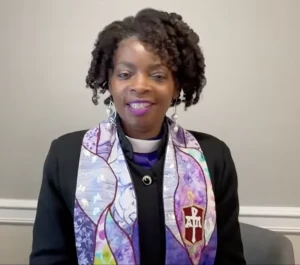 Joining virtually due to emergency kidney stone surgery the day prior, Bishop Cynthia Moore-Koikoi, who serves the Eastern Pennsylvania & Greater New Jersey Annual Conferences, preached on Jesus’ first word from the cross, “Father, forgive them; for they know not what they do.” She offered a message centered on the radical and costly nature of forgiveness. Reflecting on both her physical pain and Christ’s suffering, she lifted up the profound grace of a Savior who, even in agony, chose intercession over condemnation. Naming those present at the crucifixion, from Judas and Peter to Roman soldiers, she emphasized that Jesus’ plea was not rooted in ignorance of wrongdoing, but in a deep desire for mercy. “Father, forgive them,” she said, imagining Christ’s appeal, “I don’t want them to experience the wrath of your anger… I’m begging you not to punish them. Help them understand that this wound in my side is for their transgressions.”
Bishop Moore-Koikoi connected that moment on the cross to the present day, calling believers to embody the same expansive forgiveness in a world marked by division, injustice, and personal offense. She challenged listeners to move beyond selective grace, extending forgiveness not only to loved ones but to those who harm, oppose, or misunderstand them. “Forgiveness is the final form of love,” she said, urging the Church to follow Christ’s example by loving neighbors and enemies alike. From those who “try to erase our history” to “those who cut me off in traffic” and “those who don’t like that I’m a Black woman,” she pressed the congregation to confront the difficulty of forgiveness while embracing its transformative power. “Forgive us all, for we haven’t got a clue,” she said, underscoring the shared human need for grace.
Second Word – Bishop Robin Dease
“Today you will be with me in paradise.”
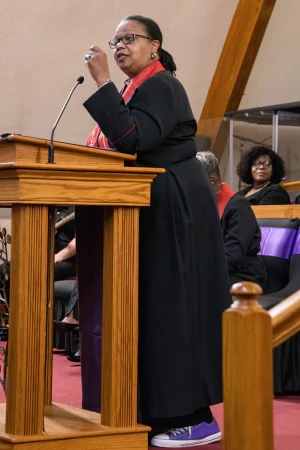 Bishop Robin Dease of the Georgia Episcopal Area preached on Jesus’ second word, “Today you will be with me in paradise,” and invited the congregation to consider the nature of goodness in a broken world. She clarified, a goodness that, like Christ on the cross, exists not in ideal conditions, but in the tension between opposing forces. Describing Jesus as hanging between two thieves, she emphasized that this moment was not just historical, but deeply reflective of the present. “Goodness does not wait for perfect circumstances,” she said. “It shows up where it is needed most.” She drew parallels to everyday life, naming the contrasts that surround us, those who do the work and those who take the credit, “Those who want the country for themselves and those who are willing to share it with others,” reminding listeners that Christ remains present in the midst of that tension.
Bishop Dease underscored that both individuals crucified alongside Jesus were guilty, yet their responses diverged; one died in his sins, the other repented, illustrating the ongoing human choice between pride and transformation. “Great sinners come closer to Jesus than proud intellectuals,” she said, noting that humility opens the door to grace in ways pride cannot. Calling the congregation to truly see one another, she referenced the familiar medical shorthand “ICU” - “I see you” - echoing the work of Alex Pretti, and lifting up the importance of recognizing the humanity in others before judging them. In a world divided between cynicism and faith, she described Christ as the bridge “between despair and hope, between judgment and mercy,” reminding those gathered that even in life’s most difficult in-between spaces, goodness endures, and the promise of redemption remains immediate: not someday, but “today.”
Third Word - Bishop Kennetha J. Bigham-Tsai
“Woman, behold your son. Son, behold your mother.”
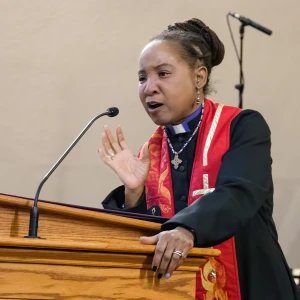 Bishop Kennetha J. Bigham-Tsai, of the Iowa Episcopal Area and the Illinois Great Rivers Episcopal Area, preached on Jesus’ third word, “Woman, behold your son. Son, behold your mother.” She centered her message on the significance of the body, both Christ’s and our own, in the context of love, justice, and human dignity. Drawing from Ta-Nehisi Coates’ Between the World and Me, she framed racism as a reality that has long been enacted on the bodies of Black people, describing it as the “appropriation, exploitation, and violation of Black people’s bodies.” She pointed to the killing of George Floyd, saying it revealed “the full force of racism” inflicted on the body. She connected this to the crucifixion “Jesus… submitted his body,” she said, “between every Black and brown body and the systems that exploit.”
Bishop Bigham-Tsai then brought Christ’s words into the present, describing them in deeply tangible terms as a call to care for one another’s bodies, just as a mother cares for a child or a child for a parent. “We cannot say that we love our neighbor and be indifferent to what happens to our neighbor’s bodies,” she said, urging the Church to confront the ongoing realities of racism, violence, and mass deportation affecting Black and brown communities. Her call was both pastoral and prophetic: “Stand up for Black and brown men and boys,” she said, while also urging protection and dignity for Black women and girls. Her message was also personal. “Our son is a young man now. He is about to go to college. We are releasing him into an increasingly racist world,” she said. “Our job is to release his hand and put it into the hand of God. My prayer is that the Church will put him into the hand of mothers who will also call him son.” She reminded the congregation that to follow Christ is to embody a love that is not abstract, but lived out through justice, protection, and care for one another.
Fourth Word - Bishop Delores Williamston
“My god, my God, why have you forsaken me?”
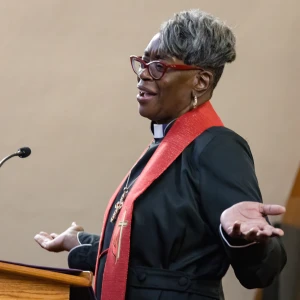 Bishop Delores J. Williamston of the Louisiana Conference preached on Jesus’ fourth word, “My God, my God, why have you forsaken me?” She drew the congregation into the raw reality of suffering, focusing on Christ’s anguished cry on Good Friday. She described it as a moment not of quiet reflection, but of deep abandonment, “a loud cry of pain and anguish” that named what it feels like to be disowned, dropped, and left alone. In that moment, she said, even the heavens were silent. Yet rather than diminishing faith, Jesus’ cry revealed its depth. “It takes courage and gumption to holler,” she said, inviting the congregation into that same honesty before God. As attendees responded with a resounding “HOLLER,” Williamston affirmed that believers are given permission to cry out in their own moments of suffering and uncertainty.
Bishop Williamston connected Christ’s experience to the realities of today, acknowledging the pain of those who feel abandoned, unheard, or betrayed, even by those who once stood close. She emphasized that faith does not always bring immediate answers or relief, but calls believers to trust God even in silence. “Good Friday reminds us that life is real, suffering is real, and being abandoned is real,” she said, while also pointing to the hope that emerges from that darkness. Naming the crucifixion as both brutal and transformative, she reminded listeners that, “it was not the end of the story, it was the beginning.” Even when God feels distant, she affirmed, God is still present, working, listening, and redeeming through every cry and every “holler.”
Fifth Word - Bishop Sharma D. Lewis Logan
“I thirst.”
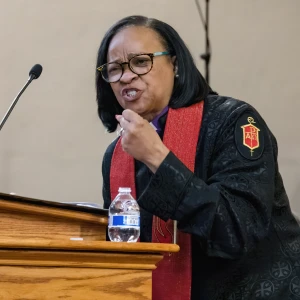 Bishop Sharma D. Lewis Logan, of the Mississippi Episcopal Area, preached on Jesus’ fifth word, “I thirst.” She explored both the physical suffering of Christ and the deeper spiritual longing reflected in his words. She described crucifixion as a brutal experience marked by “extreme pain, agony, blood loss, and dehydration,” explaining how dehydration occurs when the body loses more fluid than it takes in, triggering thirst and leading to symptoms like weakness, confusion, and dizziness. Yet she quickly expanded that physical reality into a broader spiritual truth, observing, “We live in a world full of thirsty people,” chasing power, validation, and fulfillment in ways that ultimately leave them empty. Even as Jesus, “the one who said, you will never thirst again, is now thirsty,” she highlighted the profound irony that the source of spiritual fulfillment fully experiences human limitation.
Bishop Lewis Logan challenged the congregation to reflect on their own lives, asking not just what they need, but what they are truly seeking. “What are we thirsting for today? What are we chasing that has not quenched our souls?” Speaking from her own identity, she declared, “I stand here thirsty,” expressing a deep desire for righteousness, justice, and a closer relationship with God.
Sixth Word - Bishop Tracy S. Malone
“It is finished.”
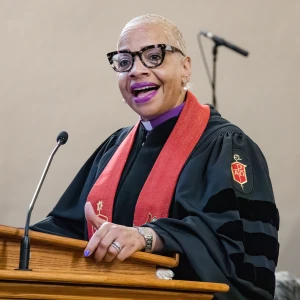 Bishop Tracy S. Malone serves the Indiana Episcopal Area and is currently the president of the General Commission on the Status and Role of Women and President of the Council of Bishops. She preached on Jesus’ sixth word, “It is finished,” proclaiming the statement not as defeat, but as a declaration of victory and completion. Opening with the hymn “Were you there, when they crucified my Lord?” she invited the congregation into the weight of the moment, describing the cross as the place “where grief and grace meet.” She emphasized that Jesus’ words were not a sigh of resignation, but a “victory shout.” This was the fulfillment of divine purpose. “He doesn’t say, ‘I am finished,’” she said. “He says, ‘It is finished,’” underscoring that Christ was not speaking of his life ending, but of the completion of his work of redemption. Everything, she explained, from prophecy to suffering, had been moving toward this moment, where “the task you gave me is completed” and “the work is done.”
Bishop Malone drew the message into the present, urging listeners to live in the freedom Christ’s finished work makes possible. “If it is finished — and it is — we do not need to keep striving to earn what God has already given,” she said, reminding the congregation that the cross has already settled the debt: “Paid in full. No balance remaining.” She challenged believers to release guilt, shame, and fear, noting that “sometimes we live like it ain’t finished,” carrying burdens Christ has already claimed. Instead, she called the Church to trust in the grace already given and to embrace the transformation still unfolding within them. Describing the cross not just as an instrument of execution but as an altar of sacrifice, she pointed to the paradox at the heart of the Gospel: “From that cry comes resurrection. From his death comes new life. From that final breath comes new hope that will never ever die.” With that final note of hope, she reminded the congregation, “What feels like loss is victory… what appears to be an ending is actually a new beginning.” She urged the congregation to remain present in the moment of Good Friday, even as the promise of resurrection draws near. Remaining at the cross, she declared that because it is finished, we are free to live differently, love deeply, and carry the gift of grace into the world.
Seventh Word - Bishop LaTrelle Miller Easterling
“Father, into your hands, I commend my spirit.”
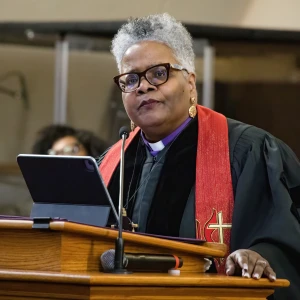 Bishop LaTrelle Miller Easterling, host bishop of the Baltimore-Washington and Peninsula-Delaware Episcopal Area, preached on Jesus’ final word, “Father, into your hands I commend my spirit.” She centered her message on the power of surrender and radical trust in God. Describing the scene at the cross with vivid detail, she emphasized that Jesus’ final words were not those of defeat, but of intentional offering. “This is not the language of helplessness,” she said, noting that even in death, “Jesus freely gives” his life into God’s hands. She framed the crucifixion not as the triumph of empire, but as its undoing, reminding listeners that God is present even in places of suffering and marginalization. What appeared to be loss, she said, was in fact transformation unfolding, a moment where “God does God’s most salvific work… in the mystery of darkness.”
Drawing together the full arc of the service, Bishop Easterling reminded the congregation that each of Christ’s final words reveals something essential about the Gospel: “Father, forgive them…” is mercy in the face of violence; “Today you will be with me…” is salvation in the face of despair; “Woman, behold your son…” is community in the face of fragmentation; “My God, why have you forsaken me…” is honesty in the face of suffering; “I thirst…” is humanity in the face of divinity; “It is finished…” is purpose fulfilled in the face of opposition; and finally, “Father, into your hands I commend my spirit…” as unrelenting trust in the face of death.
In her closing, Bishop Easterling turned toward the future of The United Methodist Church, connecting Christ’s surrender to the work ahead. “If we really want to have a future… if we really want to transform,” she said, “then what we better do is say, God, into your hands we put our pews… our pulpits… our preachers… our bishops… into your hands, God, we put everything.” Emphasizing the upcoming Council of Bishops Leadership Gathering in October, she acknowledged the importance of planning and discernment, but insisted that true transformation requires complete trust. “That which is entrusted to God can never ever fail,” she said. “God, into your hands, we place our all.” Her words served as both a benediction and a call to action, urging the church to move forward not in fear, but in faithful surrender.
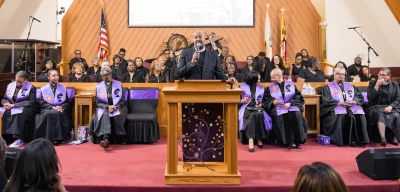 As the service concluded, the bishops were each gifted a Seven Sisters of the Spirit episcopal stole. The service also featured a range of artistic and communal expressions, including an original spoken word piece by the Rev. Keisha Dukes, liturgical dance by Josie Hoover and a mass choir of more than 30 singers from across the episcopal area. The offering during the Good Friday service benefited St. Mark UMC’s new “HER Future” initiative, and a pre-service “girl talk” panel brought together four past Seven Sisters preachers to reflect on the tradition’s legacy.
A recording of the full service is available to view on YouTube.