Representative from the Episcopal Area gather for United to Love Prayer Service
Representatives from throughout the Baltimore-Washington and Peninsula-Delaware Annual Conferences gathered at Wesley Theological Seminary in Washington, D.C., April 21, for a prayer service to celebrate the 67 congregations throughout the area who received Love in Action grants this year.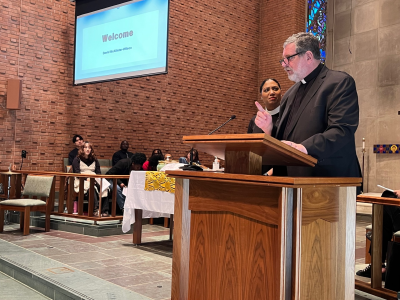
More than $150,000 in grants were given to assist communities of faith in doing ministry with people in the margins (a full list of those receiving grants is at https://www.united2love.org/).
In his welcome to the service, the Rev. David McAllister-Wilson, president of the seminary, noted that in the midst of the cruelty and war “emanating from this city,” even a prayer service is important. Quoting from the late Pope Francis, McAllister-Wilson said, “First you pray for the hungry, and then you feed them.”
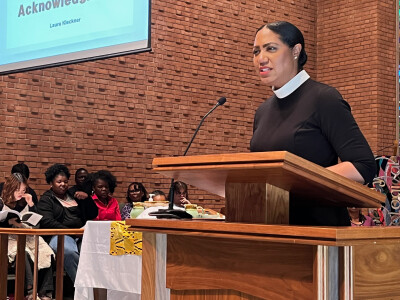 The Rev. Stacy Cole Wilson, Executive Minister of Beloved Community and one of the organizers of the service, said that the day was all about the love of Christ.
“Today is all about the church inviting the love of Christ in a way that both affirms that God is just, and God cares about the crowds suffering and yearning for justice,” she said. “Together, we are joining across the entire area to share our collective prayers for the people, to share the Word in response to that, to have a time of chanting and singing, a time for listening to witnesses, and a time for silence.”
During the service, the Rev. Cassanda Núñez, Area Hispanic/Latine and Multicultural Ministry Coordinator, offered her witness to some of the situations and ministry opportunities she has encountered.
Núñez, who previously pastored a church that became a resource hub for immigrants, share how people she met were affected by some of the current realities in the United States.
“It became a place where people could come and be greeted with love,” she said. “We became a place that was trusted. People knew that they would be seen, and heard, and accepted.”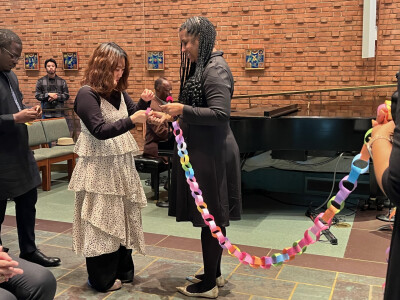
Trust, she said, is critical when being in ministry with people, especially people who are scared or afraid of what might happen to them. And because of that trust, she added, she was invited into stories; stories of parents who had their children suddenly taken away from; stories of women and men who hadn’t seen their spouses in months – or longer – because they were removed; stories of parents doing everything they can to provide for their children even as they navigate that were not built with them in mind.
Having served a predominately Hispanic congregation before, Núñez said that deportations and detentions are nothing new to her or her community.
“This is an ongoing thing,” she said. “But the violence inflicted upon people and the persecution that is so evident is a change.”
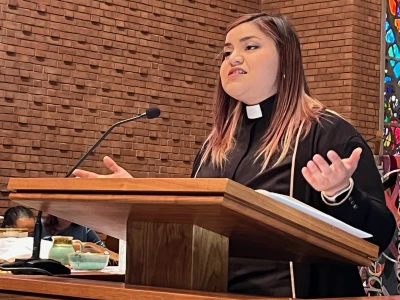 Núñez noted that justice work really begins in relationships.
“Not in theory, but in practice,” she said. “Justice work is not just about advocacy, although that is important. It is also accompaniment. It is choosing to listen when it would be easier to turn away. It is standing with people, not speaking for them. This work is not easy.”
Cole Wilson said that it is important not only to hear the Word, but to put it into action.
“Not only are we speaking God’s Word, but are transformed by them,” she said, “and we take those words from this place and we live the Gospel in ways alleviate suffering and make the world more just.”
The money for the grants for local church ministries – most of it made possible by a Lilly grant, and the rest from mission share giving from local churches, Cole Wilson said – are as wide-ranging and varied as the communities they serve.
“From affordable housing to diaper pantries, from support of unhoused people to feeding people,” she said, “if there is some need (the church) is meeting in the community that helps individuals to have their basic needs met, they could receive a grant.”
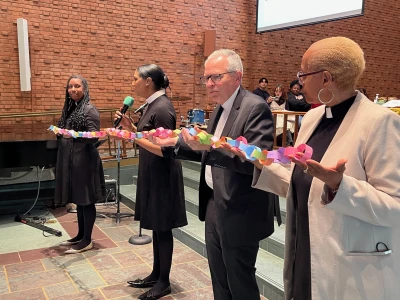 The service concluded with an offering of prayers, written by the congregation on slender slips of paper and then formed into a literal prayer chain, and the celebration of Holy Communion.
Local churches can receive information on the grant process through a link of the United to Love website, https://www.united2love.org/contact.
*Erik Alsgaard is a retired Elder in the Baltimore-Washington Conference