
Opening Worship Urges Church to Practice “Bold Love” in Hostile Conditions
By Alison Burdett
Director of Communications
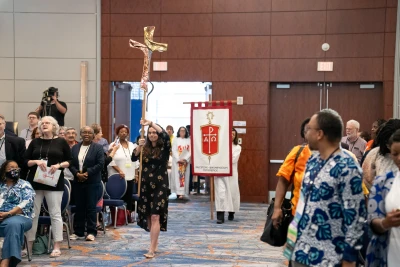 The 242nd session of the Baltimore-Washington Annual Conference opened Wednesday evening with a worship service that blended prophetic preaching, sacred ritual, multicultural expression and a bold call for the church to embody Christ’s love in a divided world.
Held at the Baltimore-Washington Conference’s Inner Harbor gathering space, the opening worship centered on the conference theme, “Love Boldly,” weaving together scripture, music, baptism and Bishop LaTrelle Miller Easterling’s passionate sermon urging United Methodists to move beyond performative discipleship into disciples capable of sustaining love even in hostile conditions.
The service began with a procession of clergy and lay leaders from across the episcopal area, followed by congregational singing of “How Firm a Foundation.” In the opening call to worship, participants proclaimed together: “We come to love boldly!”
Worship highlighted the diversity and interconnectedness of the Baltimore-Washington and Peninsula-Delaware Area, now embodied through a new processional cross created by Laurie Hill of Woodsboro, MD. Scripture was read in both English and Korean, and sacred movement, performed by Josie Hoover, accompanied the New Testament reading from Ephesians.
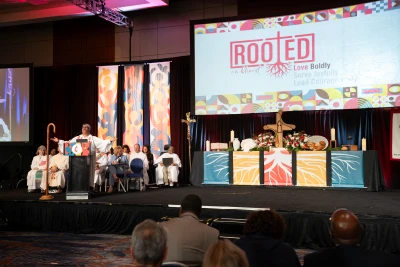
At the heart of the evening was Easterling’s sermon, “Embodying the Call to Love Boldly,” based on Ephesians 3:16-19. Drawing from the musical Rent, the bishop opened by reciting “Five hundred twenty-five thousand six hundred minutes. How do you measure a year?” She continued and asked how people measure a meaningful life and whether the church has become too focused on institutional metrics instead of transformed lives.
“We have dashboards and data points, graphs and goals,” she said. “We track baptisms, professions of faith, worship attendance, online reach, missional outreach, and giving trends to measure effectiveness.”
While acknowledging that metrics can help churches evaluate stewardship, the bishop urged worshippers to consider deeper spiritual questions.
“I wonder if God measures not merely how many ministries we sustained, but whether those ministries embodied the expansive love of Jesus the Christ,” Easterling preached.
Throughout the sermon, Easterling emphasized that the application of the instruction matters.
“The Pauline author is not speaking about mere affection,” she said. “He is speaking about authentic formation. He is speaking about the reconstitution of human community through the power of divine love.”
Perhaps there has never been a more urgent time for the church to hear that prayer than right now, Bishop Easterling suggested. “In this season love cannot remain theoretical. In this season love demands embodiment.” Bishop Easterling said that is why the author of Ephesians prays for spiritual strengthening, saying, “that according to the riches of God's glory. God may grant that you may be strengthened with the power of the Holy Spirit.”
The bishop also reflected on the spiritual challenges facing both society and the church in a time marked by division, hostility and fear. She warned against forms of Christianity that prioritize power over compassion or neglect Christ’s teachings on mercy and justice.
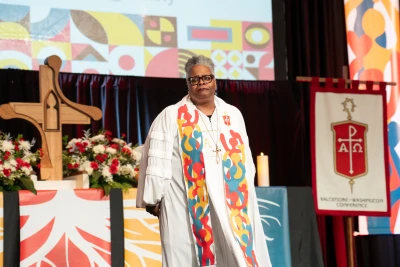 “And I must confess that my spirit grieves deeply when I witness a nation of immigrants torturing immigrants in the name of an immigrant Jesus,” Easterling declared twice, to sustained applause so loudly affirming, that you could hardly hear her say it a second time.
“The church ceases to be a prophetic community and becomes merely another institution bowing at the altar of power, prestige and evil,” she said.
Referencing theologian Dietrich Bonhoeffer, Easterling spoke about the barriers that divide people and that “Christ stands between us, and we can only get in touch with our neighbors through Christ.”
“In Christ, the immigrant is not first a stranger; rather, they are our brothers and sisters,” she said. “The poor are not social burdens; they are the least of these from Matthew 25.”
Her sermon repeatedly returned to the necessity of public witness, especially in what she described as “hostile conditions.”
“We don’t get to compartmentalize our lives,” Easterling said near the conclusion of the message. “We don’t get to say we will stand against evil in whatever forms it presents itself and then support somebody who does nothing but practice evil on a daily basis.”
“This conference helped lead the way for 2,000 people to gather in faithful resistance to injustice toward immigrants,” Easterling said. “And then people who had nearly given up hope encounter signs that another world is still possible under the reign of God.”
Bringing the sermon back to the song from Rent, Bishop Eastling asked, “after another five hundred twenty-five thousand six hundred minutes, will we have embodied a bolder love?”
Following the sermon, an offering was received for Seeds of Security, a ministry founded by Bishop Easterling and her husband, Rev. Marion Easterling, that provides advocacy, resources and safe haven for survivors of domestic violence and intimate partner violence. The evening’s offering totaled $6,115.
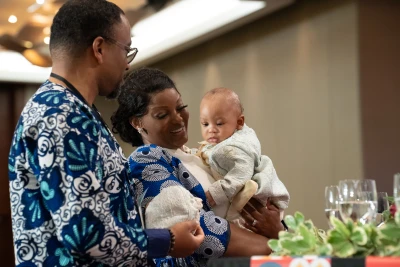 The service also featured the baptism of André-Noël M. A. Briscoe III, son of Rev. Andre R. Briscoe Jr. and Tamika L. Briscoe. As worshippers later were sprinkled with water during a remembrance of baptism, the congregation sang “I Am Thine, O Lord.”
In her benediction, Easterling returned to the conference’s central theme.
“As this time of worship ends and we leave this sacred space, know that God has already prepared the way,” she said. “Go forth in the power of the Spirit to love boldly.”
The service concluded with jubilant singing of “You Are Good” as clergy and worship leaders recessed from the worship space, launching the Annual Conference session with a call to embody bold love through both worship and witness.