
MLK Jr. Day of Prayer Calls Church to Prophetic Participation
By: Alison Burdett
 On Tuesday, January 20, a MLK Jr. Day of Prayer and Prophetic Witness service, was held in Simpson Memorial Chapel at the United Methodist Building in Washington, D.C., at noon. The service blended worship, lament, and a call to faithful action in the spirit of the Rev. Dr. Martin Luther King Jr.
Hosted by the General Board of Church and Society (GBCS), the service invited participants to move beyond commemoration toward faithful, public action rooted in prayer and justice.
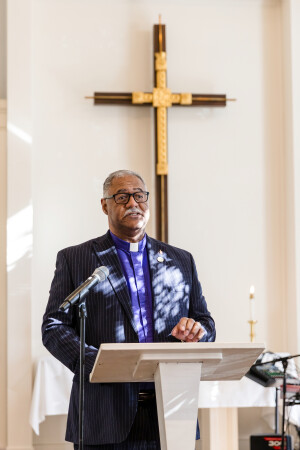
The gathering opened with music led by the Rev. Wayne Wilson, joined by vocalist Melissa Constantin, setting a reflective tone for the service. Bishop Julius Trimble, general secretary of GBCS, welcomed those assembled, naming the United Methodist Building as a historic place of witness that calls government to a higher moral ground and insists that the welfare of the people cannot be ignored.
“We too often have been guilty of sanitizing and redacting the radical nature of Dr. King’s ‘I Have a Dream’ speech,” Bishop Trimble said. He pointed to King’s insistence on “the fierce urgency of now” and challenged the church to confront the erosion of due process, the normalization of cruelty, and policies that abandon the most vulnerable, quoting Psalm 11:3, “If the foundations are destroyed, what can the righteous do?”
He reminded the gathered community that the United Methodist Social Principles affirm that every form of government stands under God’s judgment and must therefore be held accountable for protecting the innocent, guaranteeing basic freedoms and liberties, protecting the natural world, and establishing just, equitable, and sustainable economies.
Aimee Hong, assistant general secretary of programs at GBCS, offered the opening prayer, giving thanks for King’s life and witness while acknowledging that the vision of the Beloved Community remains unfinished. A musical interlude followed, including the hymn “You Raise Me Up,” underscoring themes of resilience and hope in the face of struggle.
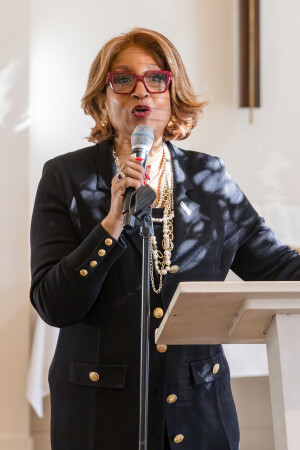 The service then turned to Voices of Witness, beginning with Bishop Vashti Murphy McKenzie, president and general secretary of the National Council of Churches. McKenzie warned that we are living in a time when evil no longer lurks in the shadows but “stalks our streets in broad daylight.” urging the church to resist being “long on commemoration and short on moral consciousness.”
“Here we are, children of the dream,” she said, calling for a love that tells the truth, disrupts lies, and refuses to salute injustice, even when it is popular or profitable. “A nation who forgets the dignity of the least of these is a nation that has already lost its soul,” she said.
Bishop McKenzie then asked the congregation to reflect, “Will we be participatory in history, or will we just be spectators?” She encouraged the church to speak truth locally, act globally, and engage in needs of resistance that we will not allow anarchy and tyranny to arrive in America.
She closed with a power claim that prophetic prayer requires prophetic participation. “Don’t leave here to leave it to someone else.”
Next, Rev. Stacey Cole Wilson, Executive Minister of Beloved Community for the Baltimore-Washington Conference, framed her reflection around King’s enduring question: “Where do we go from here, chaos or community?” Drawing on biblical and contemporary examples, Rev. Cole Wilson described a moral crisis that includes racism, militarism, economic injustice, environmental harm, and mounting threats to civil rights and civil liberties.
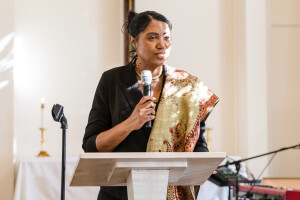 Rev. Cole Wilson outlined three calls for this moment:
- Conviction over comfort: “The church was never meant to be comfortable,” she said. “It was meant to be faithful.”
- Courageous compassion: “When one community is targeted, the church does not ask, ‘Is this our issue?’ The church must declare, ‘This is our neighbor.”
- Collective nonviolent action: “Scripture reminds us that Faith without works is dead. Worship without justice is empty.” She urged participants to carry their faith into streets, schools, courtrooms, and community spaces.
Rev. Cole Wilson declared that the church must not be known for who it excludes, but who it protects, and that if justice does not come quickly, we will still preach it.
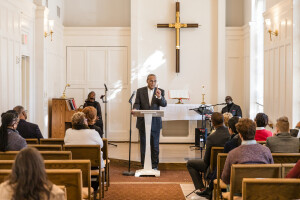 The final voice of witness came from U.S. Rep. Emanuel Cleaver II (Missouri-5th), who arrived late to the service after receiving a call from police while traveling. Cleaver explained that authorities had contacted him regarding activity at his church in Kansas City. Participants were grateful to hear that the Honorable Emanuel Cleaver II received confirmation that his son was safe amid the ongoing investigation.
Rep. Cleaver reflected candidly on the fragility of civil rights gains, warning that the nation is entering what he described as “Act Two” of the civil rights movement. “This is not some hype around Dr. King’s birthday,” he said. “This is real.” Drawing from history, personal experience, and even popular culture, Cleaver emphasized the importance of moral imagination. Quoting the Star Wars scene when Luke Skywalker turns to Yoda and says, “I don’t believe it,” Yoda concluded, “That’s why you fail.” This illustration was urging the attendees to believe in and envision a democracy worthy of future generations.
Rep. Cleaver recounted a story from Dr. King’s life, describing a moment when King, as a young student, was denied a train ticket because he lacked the proper luggage. As King sat crying, a tall stranger opened his leather pouch, paid for the ticket, and then turned and walked away without a word. “He turned and walked away,” Cleaver repeated, emphasizing the quiet, sacrificial dignity of the act. The story, he said, stands in stark contrast to a culture that demands recognition and credit, reminding listeners that justice is often advanced by ordinary people who choose compassion without applause or recognition.
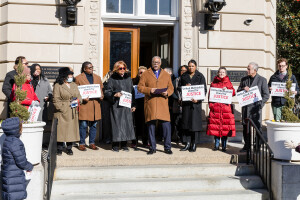 The service concluded in front of the United Methodist Building where Bishop Trimble offered a closing charge and benediction, sending the gathered community forth to embody what had been proclaimed. One refrain throughout the service was made clear, prophetic prayer is incomplete without prophetic action.