Jones Memorial UMC Installs EV Chargers, Putting Faith and Creation Care “on the Pavement”
By Alison Burdett
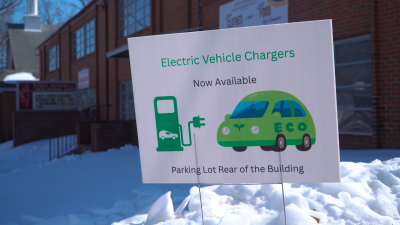
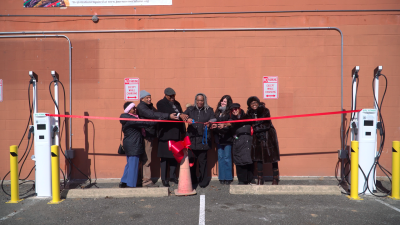 On February 13, Jones Memorial United Methodist Church in Ward 7 commissioned two new electric vehicle charging stations. This is a visible and practical expression of the congregation’s commitment to creation care, environmental justice and community transformation.
Installed in partnership with Citizen Energy, the dual-port Level 2 chargers are part of a broader vision to transform the church campus into a model “Green Building” and neighborhood hub for sustainability education and workforce development.
Through a combination of grant funding and federal and local tax credits, Jones Memorial qualified for a fully funded installation, enabling all charging equipment and the necessary infrastructure to be offered at zero cost to the church property.
For Rev. Sharee Wharton, Director of Missions, Outreach and Sustainability and chairperson of the Baltimore-Washington Conference Creation Care Team, the project is rooted firmly in the United Methodist Social Principles.
“In Ward 7, these chargers are our way of putting the Social Principles into action, literally by putting them on the pavement,” Wharton said.
For the past two years, the church has partnered with a University of Maryland-affiliated environmental research group to monitor neighborhood air quality. A sensor attached to the building takes daily readings, especially during early morning hours when commuter traffic is heavy and children are walking to school.
“In these particular wards, there is a higher percentage of families that are exposed to air pollution,” Wharton said. “There are a lot of children in our community that deserve to breathe easier, so we’re willing to use our land, our influence in the community and our faith to make that happen.”
The EV chargers are one step in a longer journey. The church has partnered with organizations including the National Wildlife Federation, Interfaith Power & Light and Interfaith Partners of the Chesapeake. It has built bioretention cells to manage stormwater runoff, installed cisterns to prevent flooding and replaced lighting throughout the building with LEDs.
“For us at Jones, it’s not an extra program when we invest in these creation care projects,” Wharton said. “We help our members see that these initiatives are part of being good stewards.”
During the ribbon-cutting ceremony, Rev. Benjamin Hall, lead pastor of Jones Memorial UMC, framed the moment as both practical and deeply spiritual. In his prayer of dedication, he reminded those gathered that the chargers represent more than infrastructure.
“May these chargers serve not only as a practical resource for our community, but as a witness to our calling to be caretakers of your world,” Hall prayed.
He continued, “Let this site be a space where faith meets action, where sustainability, hospitality, and justice come together for the good of all people.”
The chargers are publicly accessible throughout the week and add to the region’s growing EV network. But church leaders hope their impact extends far beyond transportation.
Jones Memorial is currently working with Citizen Energy and other partners to launch an 18-month workforce development pilot focused on clean energy careers. The initiative would provide training, certification and job placement assistance in fields such as solar installation, HVAC and energy auditing, with a goal of creating up to 50 job opportunities for residents of Wards 7 and 8.
“Supporting the environment is also a way to support people’s economic status,” Wharton said. “By having very good-paying jobs that do these things.”
The church hopes to launch the pilot by September, pending funding.
Partnerships have been key to the congregation’s progress. Wharton describes herself as “a big proponent of partnerships,” noting that collaboration with colleagues and denominational networks often leads to grant opportunities and shared resources. Many of Jones Memorial’s sustainability efforts have been supported by grants and connectional relationships. For Wharton, that’s a model other congregations can follow.
When neighbors see EV chargers in a church parking lot, she hopes it sparks reflection.
“I pray that people start to make more connections about what God is telling us when He’s talking about creation, that it’s all inclusive,” she said. “What is coming out of the pulpit is just as important as what is going out into the environment.”
Her encouragement to other United Methodist congregations is simple: "begin."
“I would urge them to start a Green Team,” Wharton said. “Get people with like-minded ideas together and begin to focus on how we can be good stewards of our planet, how we can be good stewards of our communities.”
It doesn’t have to start with EV chargers. “If it’s not EV charging, it could be recycling. If it’s not recycling, it could be planting a pollinator garden… You’d be surprised how impactful you can be in your community.”
Ultimately, the commissioning marked more than the unveiling of new equipment. As Hall prayed, it was a dedication of “this ground and these chargers to your glory,” asking God to “bless every vehicle that draws power here” and to make the site a reminder that “your Spirit is renewing the earth and calling us to be partners in that renewal.”