He Helped Expand the Role of Deacons. Then God Called Him to Be an Elder.
By Alison Burdett
Director of Communications
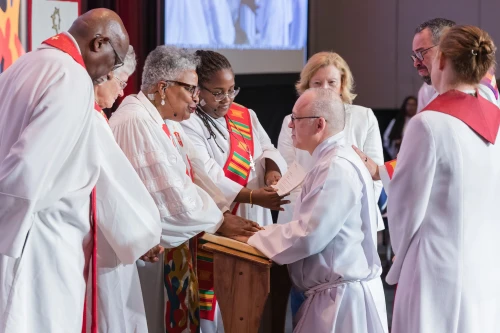 When Rev. Leo Yates was ordained an elder during the Baltimore-Washington Conference's 2026 Annual Conference session, the moment represented more than a new title. It marked the culmination of a ministry journey nearly three decades in the making.
Ordained a deacon in 2018, Yates had become a passionate advocate for diaconal ministry and opportunities for deacons serving congregations and specialized ministries. Yet, as he co-authored the legislation that expanded sacramental authority for United Methodist deacons in 2024, he was simultaneously discerning that God was calling him to become an elder.
For many years, United Methodist clergy followed a deacon-to-elder pathway. While that transitional system ended in 1996, Yates’ journey has uniquely allowed him to experience both orders of ministry.
In 1999, while serving as an American Sign Language interpreter at Community United Methodist Church, Yates experienced a vivid vision that would change the course of his life.
"I had a vision of myself preaching in sign language to a Deaf congregation," he recalled. "It was very concrete."
The vision came as no small surprise. Yates comes from a long line of United Methodist clergy in the Holston Conference, including his grandfather, uncle, cousin and two great-uncles. Knowing the demands of ministry firsthand, his initial reaction was less enthusiasm than apprehension.
"When I came out of the vision, I thought, 'Oh no,'" he said with a laugh.
But the call persisted. Conversations with family members, clergy mentors and Bishop Peggy Johnson, then pastor of Christ Church and a longtime advocate for Deaf ministry, helped him begin the ordination process.
Johnson would become one of the first people to encourage him to consider the Order of Deacons. At the time, Yates felt strongly drawn toward Deaf ministry. The son of Deaf parents and the brother of another professional interpreter, he had spent much of his life immersed in Deaf culture and community.
Yet his path toward ordination was not straightforward.
As a queer United Methodist pursuing ministry before the denomination's recent changes regarding LGBTQ+ clergy, Yates encountered significant barriers during the ordination process. Rather than leave the church, he chose to remain engaged in the work of helping it evolve.
"I'd rather be part of the work to change than fall away," he said. "A lot of people understandably left because they no longer wanted to be oppressed. But I felt called to stay and help bring change. I didn't want to participate in my own oppression."
During that season, Yates earned a master's degree in clinical counseling and later became a licensed therapist. He eventually returned to the ordination process and was ordained a deacon in 2018.
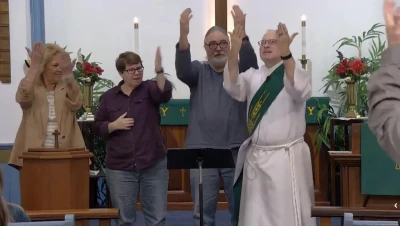 For eight years, he faithfully served in that role. Yates has served as pastor of Magothy United Methodist Church of the Deaf in Pasadena since 2023. He also serves as the Baltimore-Washington Conference's Accessibility and Inclusion Coordinator. In addition to those roles, he serves in leadership roles with the United Methodist Congress of the Deaf and the denomination's Deaf & Hard of Hearing Ministries Committee and teaches as an adjunct professor at Wesley Theological Seminary.
Ironically, it was while teaching a seminary course on the history and ministry of deacons at Wesley Theological Seminary last year that Yates found himself confronting a new realization.
"As I was doing the research for the course, I could see that I was really doing the work of an elder," he said.
"My ordination vows are a holy commitment. I felt like I needed integrity in my role. I was doing the work of an elder, and I needed to own that."
The discernment process was extensive. Yates consulted fellow deacons and elders, read widely, met with mentors and even sought guidance through therapy.
The response was remarkably consistent.
"People kept telling me, 'It sounds like you're doing the role of a shepherd,'" he said.
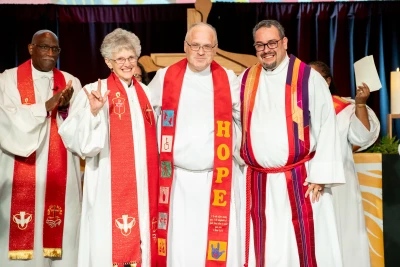 One person who was not surprised was Bishop Johnson, whom Yates invited to serve as his co-sponsor, along with his husband, Rev. Giovanni Arroyo, during this year's ordination service.
"Leo, you were first called to be an elder," she told him.
Now, as an elder, Yates plans to continue serving Deaf communities and hopes to help establish additional Deaf ministries across the Baltimore-Washington Conference. Under his leadership, Magothy United Methodist Church of the Deaf has experienced significant growth, welcoming 14 new members in 2024 and eight more in 2025. The congregation, once facing an uncertain future, now includes children in worship and is exploring new ministries for young adults.
He also hopes to continue mentoring others who are discerning calls to ministry.
"People paved the way for me," Yates said. "And I'm a believer in paying it forward."
Reflecting on the journey, he sees God's hand throughout every chapter.
"God continues to be persistent in my calling," he said. "I may have lost faith at times in our system, but God has always been faithful. And truthfully, I feel like I'm a better elder because I was first a deacon."
For Yates, becoming an elder is not a departure from the ministry that has shaped him. Rather, it is the next faithful step in a calling that began with a vision, was refined through years of service and discernment, and continues to unfold among the people he loves serving most.