
Faith Lessons from 1968, Ahead of Artemis II
By: Shannon Katz-Dean
Archives Administrator
The last time a U.S. astronaut set foot on the moon was Dec. 19, 1972, during NASA’s Apollo 17 mission. More than 50 years later, humanity stands on the threshold of a new era in space exploration. NASA’s Artemis II mission, intended to launch on April 1, will carry astronauts farther than any human has traveled since Apollo, marking a renewed commitment not only to return to the moon but also to establish a sustained human presence there and eventually journey onward to Mars.
For many, this moment is about science, innovation and exploration, but it also invites deeper reflection.
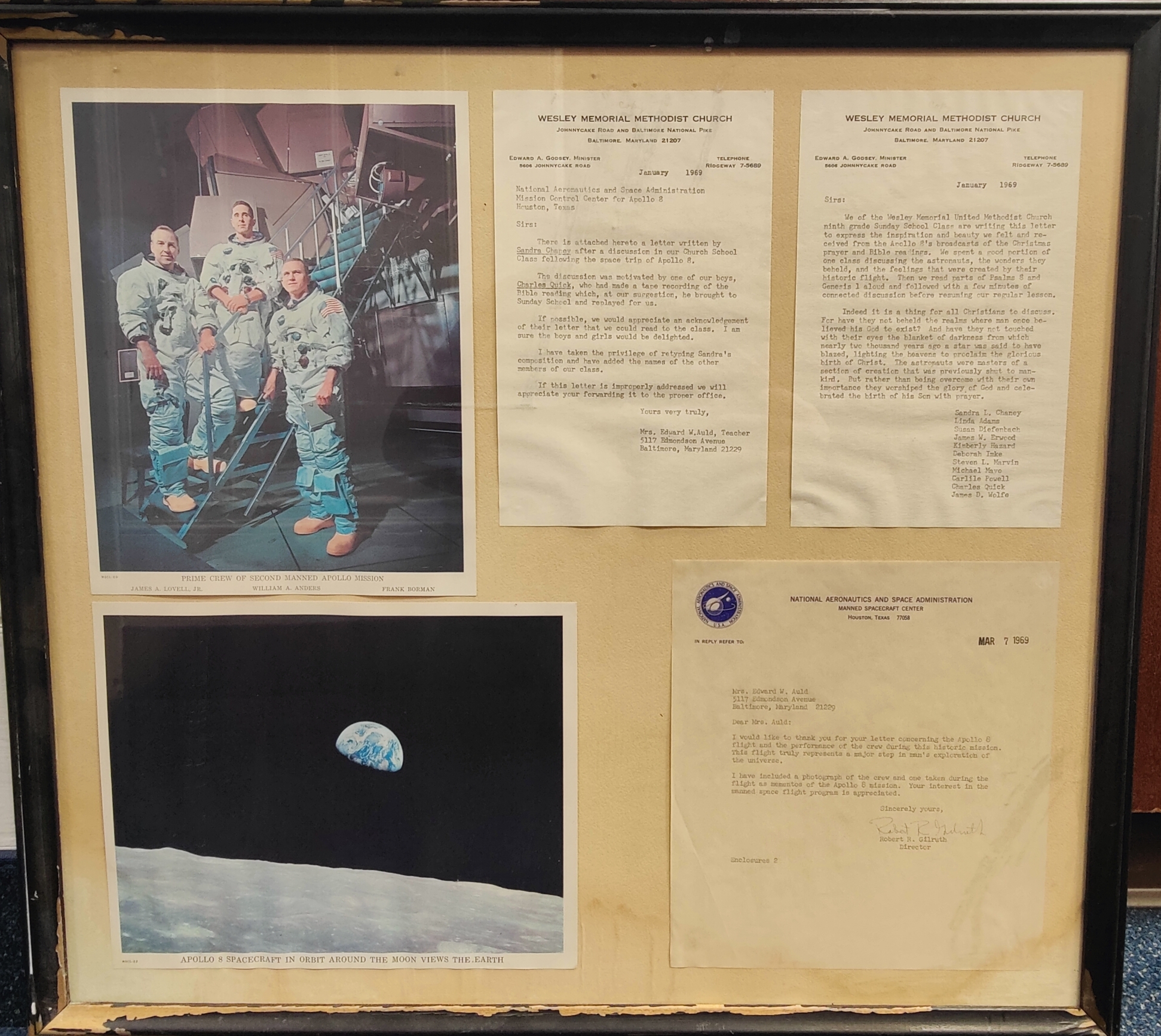 Recently uncovered from the archives of the Lovely Lane Museum is a framed collection of letters and images connected to Apollo 8, the groundbreaking mission of Dec. 21–27, 1968. Apollo 8 made history as the first crewed spacecraft to leave Earth’s gravitational pull and orbit the moon. While Apollo 11 would land on the lunar surface months later, Apollo 8 was the first time human beings witnessed Earth from deep space.
On Christmas Eve of that year, astronauts Frank Borman, Jim Lovell and William Anders did something unexpected. As millions listened around the world, they broadcast a live message from lunar orbit. Rather than focusing solely on scientific achievement, they turned to Scripture, reading the opening verses of Genesis: “In the beginning God created the heaven and the earth…”
That moment resonated with a ninth-grade Sunday school class at Wesley Memorial Methodist Church in Baltimore. The students responded by writing to NASA, asking profound questions: What did it feel like to behold realms once thought to be God’s heavens? What did it feel like to be deeper in the vast darkness that held the star that identified Christ’s birth? What was it like to touch a part of creation that had never been accessible to humanity? Was it hard to have your faith tested like that?
The students from Wesley Memorial recognized something essential: that wonder and mystery are not enemies of faith, but sacred spaces where faith can grow. As Artemis II carries astronauts once again beyond Earth’s orbit, it invites us to look up with scientific curiosity and with spiritual openness.
The Artemis generation stands not just on the edge of technological achievement, but at the intersection of wonder, belief, and the enduring questions of faith.
Faith is always tested. When unknown or upended expectations threaten to break your faith, wrestle with them. Maybe your hip becomes displaced like Jacob, and you are blessed. Maybe your lamentation gives way to praise and homecoming. After all, Good Friday leads to Easter Sunday. Despite the scope of these awe-some and fear-some experiences, humanity has worshiped the glory of God and celebrated the birth of God’s Son from space.
Have faith, and look up.