Faith Leaders Advocate for Justice at MD Legislative Advocacy Day
By Alison Burdett
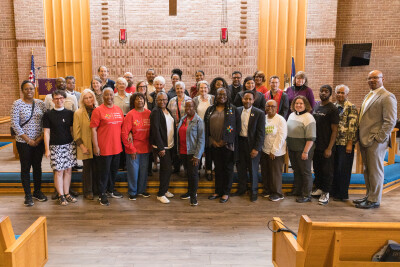 Clergy and lay leaders from across the Baltimore-Washington Conference gathered March 11 at Asbury United Methodist Church in Annapolis for the conference’s annual Legislative Advocacy Day, preparing to meet with lawmakers and speak on issues ranging from healthcare access and gun violence prevention to immigration justice and creation care.
Participants began the morning with check-in and breakfast before Rev. Michael Parker, pastor of Asbury United Methodist Church, welcomed attendees and offered the opening prayer.
“We are grateful and thankful for the gift of this day,” Parker prayed. “God, as we seek justice, not just us, but justice for all, may our witness be bold, brave and courageous as we go to the state’s capital.”
Minister Christian S. Watkins then helped frame the purpose of the gathering, reminding attendees that advocacy is rooted in faith and the ongoing work of building the Beloved Community.
“We stand on the shoulders of those who have come before us,” Watkins said. “We carry out what it means to build beloved community by doing the work.”
The morning included briefings from advocates who explained several bills currently before the Maryland General Assembly.
Miriam Williams, Social Action Coordinator for the Baltimore-Washington Conference United Women in Faith, highlighted the organization’s justice priorities for 2025–2028: climate justice and ending mass incarceration and the criminalization of communities of color.
“For more than 150 years we have been a force for social justice advocacy,” Williams said. “Legislation is a powerful tool we can use to make the changes we’re seeking systematic and lasting.”
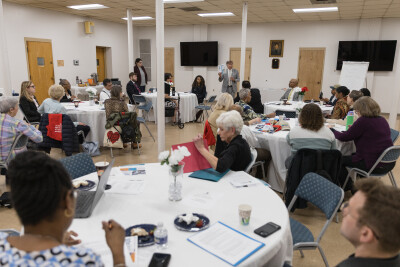 Healthcare policy was addressed by Vincent “Vinny” DeMarco, president of the Maryland Healthcare for All Coalition. DeMarco spoke about the importance SB 987/HB 484, which would eliminate state tax deductions for prescription drug advertising and redirect an estimated $24 million in savings toward healthcare programs that help Marylanders maintain coverage. He also noted the impact faith-based advocacy has already had on healthcare access in the state.
“Maryland has reduced the percentage of uninsured residents from 13 percent to about 6 percent,” DeMarco said, crediting collaboration among advocates, lawmakers and community organizations.
Gun violence prevention was another focus of the day. Susan Bender, who leads the conference’s Gun Violence Prevention Social Action Team, described legislation aimed at addressing emerging firearm technologies and strengthening protections for victims of domestic violence.
One bill, SB 334/HB 577, targets conversion devices that can transform semi-automatic pistols into fully automatic weapons. Another measure, SB 20/HB 83, the Family and Law Enforcement Protection Act, would require individuals subject to temporary protective orders in domestic violence cases to surrender firearms immediately.
Immigration policy discussions included personal testimony from Rev. Cassy Núñez, the conference’s Hispanic/Latine and Multicultural Ministries Coordinator. Núñez shared her own experience navigating the U.S. immigration system after arriving in the country as a child.
“If this feels like an issue far away from you, here I am,” Núñez told attendees.
Núñez explained the Community Trust Act (SB 0791), which would require a judicial warrant before a person could be detained or transferred to federal immigration authorities and would prevent local police and correctional officers from sharing information that facilitates immigration enforcement. Núñez said measures like this help ensure that immigrants feel safe accessing churches, public services and community institutions. Núñez also explained SB 504, which would restrict state and local agencies from sharing sensitive personal data, including biometric, DMV and location information, with federal immigration authorities, helping prevent that information from being used to target immigrant communities.
Environmental stewardship was also addressed during the briefings. Rev. Neal Christie highlighted legislation on behalf of the conference’s Creation Care Team to improve recycling and manage the environmental impact of large-scale data centers.
After the morning presentations, participants gathered for a group photo before sharing lunch and organizing into teams to visit legislators at the Maryland State House.
During one legislative meeting, participant Zamuel Haque of Covenant United Methodist Church in Montgomery Village shared how immigration policies and social systems can affect families and communities. Reflecting on his father’s experience immigrating to the United States from Bangladesh and working as a physician, Haque described both opportunities and barriers to being an immigrant in the United States.
“I could see the opportunities to be successful,” Haque said. “But I also witnessed those barriers that pop up. Sometimes people know about them, sometimes they don’t because they don't know about them, or it's willful ignorance.”
Haque added that advocacy work often requires patience and persistence as communities push for change. “Sometimes you have to put in the incremental changes in order to get to that point where things start shifting,” he said.
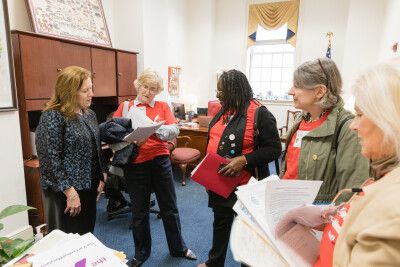 Advocates used these personal stories alongside policy explanations as they spoke with legislative staff about the issues.
During the meeting with staff in the office of Sen. Benjamin F. Kramer, Tammy Shay thanked participants for their engagement in the legislative process and encouraged them to continue sharing information within their communities.
“I’m glad you’re paying attention to all of this,” Shay told the group. “Because you all affect so many in your network and your community, you can let them know what’s happening in the state of Maryland. And it is a great place to live.”
The visits underscored the role faith communities can play in connecting public policy with lived experiences.
Among those attending the advocacy day was Blake Collins, an associate pastor of a Presbyterian church in Darnestown, Maryland. Collins first became connected with United Methodist advocacy efforts after being invited by Rev. Ken Hawes to attend the Faithful Resistance event in Washington, D.C. At that gathering, Collins was paired with Williams for legislative visits and later invited to participate in Maryland’s Legislative Advocacy Day. His participation reflected the growing collaboration among interfaith communities in the region.
Following the legislative meetings, participants returned to Asbury UMC to debrief their conversations and reflect on next steps for advocacy within their congregations and communities.
Watkins encouraged attendees to continue the work beyond the event.
“Each one of us has a circle of influence,” he said. “We’re advocating not just for ourselves, but for our families, our friends and those who come after us.”
For more opportunities to engage in social justice, subscribe to the Advocacy & Action newsletter.