Early Black Methodists in United Methodist History
By: Rev. Bonnie McCubbin
Director of Museums and Pilgrimage
February is Black History Month and each week, Archives and History will introduce you to an underrepresented or overlooked Black Methodist in our history. Early Methodists were anti-slavery. Over time, we were segregated by race, only to join back together again in 1939 with a new form of segregation that was ultimately removed in 1968 with the merger of the Evangelical United Brethren and the Methodist Church. Today, we continue this journey as we seek to become anti-racist in our ministry. Check back each week in February to learn more.
Week 1: Mary (Annie) Sweitzer
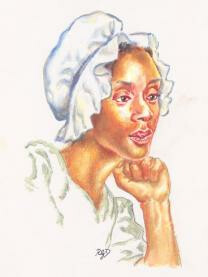 The earliest Methodists in America could be found in what is now Carroll County, Maryland, along Pipe’s Creek, as early as about 1761 (the exact date is unknown), under the leadership of Robert and Elizabeth Strawbridge. They formed class meetings to encourage accountability and faithful Christian living among the members.
Early minutes of class meetings and religious societies document the presence of Black members. The log meetinghouse, the first building built expressly for Methodist worship in America, was built on Sam’s Creek, not far from the first class meeting site. The Strawbridge Shrine Association keeps alive this history, and tells the story of enslaved persons, Mary Sweitzer and Jacob Toogood, who were members of Strawbridge’s First Class Meeting and attended worship in the Log Meetinghouse. Next week will feature Jacob Toogood.
Mary Sweitzer is frequently listed in our history as “Annie Sweitzer.” This is the same person. Annie is a modification of “Aunt Sweitzer,” an honorific used for Mary. There is little record of Mary (Annie) Sweitzer's history. She met with the class at the John Evans House as an equal member of the class, despite being of African descent and enslaved. Her name appears in the class lists.
This class was a covenant group that not only met together to study the Word of God, but also to hold one another accountable for their faith lived out in daily life. Members of the class were required to be present regularly. If a member missed more than 2 meetings, they were expelled from the class. Mary was a full member of this group of Christians discerning God’s calling in their lives, so she must have attended regularly.
Additional Resources:
“Methodist History: Slave Welcomed as Church Member.” United Methodist Communications, 2015.
Strawbridge Shrine Association: To learn more about the early class meetings, mini-pilgrimages to The Strawbridge Shrine can be arranged April-October, by contacting the Curator at www.strawbridgeshrine.org.
Week 2: Jacob Toogood
In the first week of this mini-series, it was established that Black people were present in the first class meetings of what would become the Methodist Episcopal Church. While historians don’t know much about Mary (Annie) Sweitzer, history has left us with a bit more information about Jacob Toogood, who was also enslaved and part of the John Evans’ Class Meeting under the leadership of Robert Strawbridge. So named because he was “too good,” Jacob was permanently indentured to the Maynard family. The well-known Methodist, Rev. George C.M. Roberts, son of early Methodist, Rev. George Roberts, an early conversation partner with Bishop Asbury, writes:
"Old Jacob Toogood was a slave of Mr. Maynard. He had permission to preach to the colored people and often was engaged in this work in his cabin. His master would frequently go to hear him; he would take the precaution to sit where Jacob could not see him, for fear of embarrassing him, and listen to the word of life, as in great simplicity the old man would give it to his hearers." (George C.M. Roberts, Centenary Pictorial Album, Being Contributions of the Early History of Methodism in the State of Maryland Baltimore: J.W. Woods (1866) 29.)
The former Strawbridge United Methodist Church on Wakefield Valley Road in New Windsor, Maryland, was a historically Black church dating to 1864 as a merger of several predecessor Black congregations that grew out of the ministry of Jacob Toogood, before closing in 2025. Pastor Toogood served as an exhorter and preacher to Black, white, enslaved, and free persons in the Strawbridge Society, even though it was initially believed that he himself spent a lifetime in bondage. The honorific “Pastor” is used because of his role, although we don’t know if he ever sought ordination.
More recent scholarship, however, shows that Pastor Toogood may have been freed. The Strawbridge Shrine’s current researcher, Rev. Bob Kells, shared that in some recent genealogical work Pastor Toogood appeared in the 1800 Census for Libertytown district in Maryland.
In the 1810 Census, there is a Jacob Toogood as Head of Household with four free persons living in Anne Arundel County. Again, Toogood is listed in the column for all others, not the free white males or females. By the 1830 Census, however, the Jacob Toogood family listed in Baltimore as “free colored,” had a Head of Household too young to be the Pastor Toogood from Strawbridge country, although it is possible it is a son of his.
Based on the census records, it seems that the old stories that Pastor Toogood was enslaved or indentured for life may have been mistaken. It seems that Jacob Toogood was freed by his master, John Maynard, sometime prior to 1800. The proximity of the names in the 1800 census makes it probable that Maynard gave Toogood some land nearby or adjacent to his property to live and possibly farm. By 1810, Toogood had moved to Anne Arundel County for unknown reasons. Rev. Kells also states that Pastor Toogood may have been buried in the Cassell Family Cemetery in Wakefield Valley, Frederick County. At that time, Frederick County was much larger than it is today, having been subdivided into what is now Frederick and Carroll Counties.
The Methodist Episcopal Church, established officially in Baltimore at the Christmas Conference of 1784, was explicitly anti-slavery in the early years. It was mandated at the Christmas Conference that a person could not own slaves and be a Methodist, except in Virginia, which had a grace period of two years to free the slaves due to the challenges in doing so in that state. It is entirely possible that there were more than two Black people or preachers present at the Christmas Conference. Tradition and records note that “Black” Harry Hoosier and Richard Allen were both present at this initial meeting to establish the denomination. However, it is possible that Jacob Toogood was also present since Freeborn Garrettson rode out at the behest of Francis Asbury to call “all” the preachers to Baltimore. Based on the census data, he was still living, and it is known that he was still preaching. If Toogood was not present at the Christmas Conference, he undoubtedly heard about the outcome soon thereafter, especially regarding the anti-slavery stance. John Maynard, having regularly sought out Methodist preaching, especially that of Toogood, may have freed him at some point after the Christmas Conference and prior to 1800 to be in compliance with the Methodist Episcopal Church mandate that a person could not be a Methodist and own slaves. By the General Conference of 1800, when the anti-slavery stance was greatly weakened, Toogood was already free and traveling about as a preacher. Anne Arundel County, Maryland, had a large Methodist presence in the early 19th Century so it makes sense that Toogood would move away from his former master and head to an area with a high concentration of Methodists.
Strawbridge Shrine Association: To learn more about the early class meetings, mini-pilgrimages to The Strawbridge Shrine can be arranged April-October, by contacting the Curator at www.strawbridgeshrine.org.
Week 3: Harry Hoosier
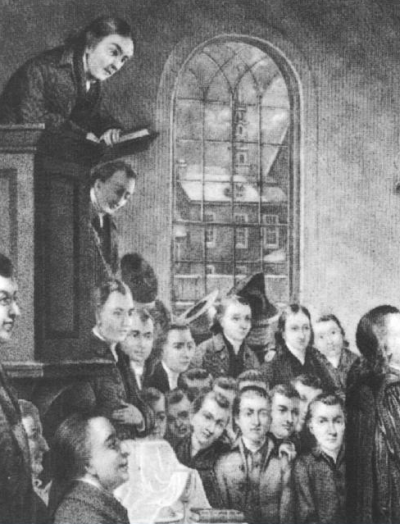 Another notable Black leader who traveled through the area during the early years of the Methodist Episcopal Church was Harry Hoosier. “Black Harry,” as he was often dubbed, was a preaching companion and carriage driver for all of the early Methodist leaders at various times: Francis Asbury, Thomas Coke, Richard Whatcoat, and Freeborn Garrettson. Hoosier was illiterate and left behind no written papers, sermons, or journals. However, secondhand accounts of him in the journals of those with whom he traveled, as well as in contemporary newspapers, paint a vivid picture of a powerful and robust preacher with a knack for memorizing Scripture.
Perhaps one of the first pioneers in what has come to be identified as Black Preaching, he left quite an impression wherever he travelled. Dr. Benjamin Rush, a noted physician based out of Philadelphia who was a signer of the Declaration of Independence and served as the physician for Cokesbury College (Abingdon, MD), stated, “Making allowances for his illiteracy, he was the greatest orator in America” (Warren Thomas Smith, Harry Hoosier: Circuit Rider, Nashville: The Upper Room (1981) 176).
Bishop Coke wrote several times about Harry Hoosier and his ability to preach, writing in his Journal on 29 November 1784:
I have now had the pleasure of hearing Harry preach several times. I sometimes give notice immediately after preaching, that in a little time Harry will preach to the Blacks, but the whites always stay to hear him. Sometimes I publish him to preach at candle-light, as the Negroes can better attend at that time.
Soon after, in the Journal entry, Bishop Coke further explains,
I really believe that he is one of the best preachers in the world—there is such an amazing power as attends his word, though he cannot read, and he is one of the humblest creatures I ever saw. (Warren Thomas Smith, Harry Hoosier: Circuit Rider, Nashville: The Upper Room (1981) 176).
Harry Hoosier was written up in New York newspapers of the time, where the paper claimed that “he delivers his discourses with great zeal and pathos…it is the wish of several of our correspondents that this same Black man may be so successful as to rouse the dormant zeal of members of our slothful white people, who seem very little affected about concerns of another world.” (The New York Packet, 11 September 1786).
Of note, while all the participants of the Christmas Conference of 1784 at the Lovely Lane Meetinghouse in Baltimore, Maryland are not documented, many are. There are at least two Black men present at the establishment of the Methodist Episcopal Church: Harry Hoosier and Richard Allen. While Harry Hoosier receives less attention in the 21st century than Richard Allen, he set the stage for Black persons and preachers to have a large impact and major influence on the establishment of The United Methodist Church and its predecessor denominations.
Additional Resources:
Mother African Zoar United Methodist Church, Philadelphia, PA
Rev. Dr. William B. McClain, Black People in the Methodist Church: Whither Thou Goest, Nashville: Abingdon Press (1984).
Week 4: Frederick Douglass
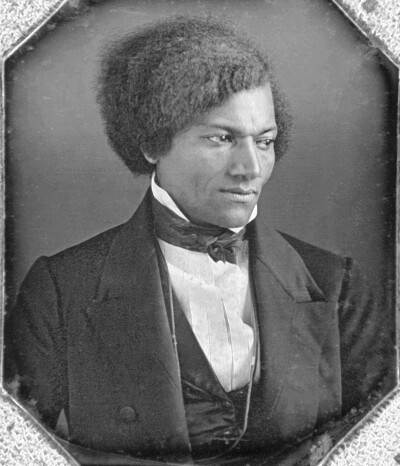 As time marched on, many Black people came through Methodist doors. One of the most famous was Frederick Douglass (ca. 1818-1895). Born into slavery on Maryland’s eastern shore, he was sent as a slave to Baltimore. In South Baltimore, particularly the Fells Point neighborhood, Douglass learned to read from the pastors at what was then called Strawberry Alley Methodist Episcopal Church before becoming free in 1838.
Strawberry Alley MEC was founded as a Class Meeting in 1772 on the afternoon of June 22, the same day the Lovely Lane Congregation was founded in the morning, but was not established as a worship congregation or preaching point until Francis Asbury visited in 1773.
Strawberry Alley MEC was integrated until 1801 when the white congregation left the building to the Black congregation and started their own church down the street, Wilks MEC. Later, this congregation became part of the Caroline Street congregation. The initial separation occurred after the 1800 General Conference removed the prohibition of owning slaves in order to belong to a Methodist Society. This is a rare example of a white congregation leaving a church. Typically, the Black congregation would separate and start their own church.
Strawberry Alley changed its name to Dallas Street when the name of the street changed. Later, it became Centennial. The Centennial and Caroline Congregations merged to form Centennial-Caroline, uniting back together the original two congregations that split in 1801. This merged congregation closed in 2016. The remnants of the congregation were absorbed into St. Matthew’s-New Life UMC on 23rd Street in Baltimore. This congregation celebrated the 250th Anniversary of Strawberry Alley on April 23, 2023, and helps to keep the story alive.
Douglass was also known to frequent Sharp Street Church, where the pastor was a mentor to him. Sharp Street maintains records of Douglass singing in the choir on occasion.
On the same land as the Strawberry Alley Church, in 1892, Douglass purchased the property to build a series of five rowhomes to rent to low-income Blacks. This strip, 516-524 Dallas Street, became known as “Douglass Place” and still stands today. While Douglass died shortly after purchasing the property and building the rowhomes, and was unable to see his dream fully realized, his impact in Baltimore Methodism and beyond is still present in the landscape and worshiping communities.
Additional Resources:
Strawberry Alley, Pilgrimage Video Series, The Baltimore-Washington Conference.
Sharp Street Memorial, Pilgrimage Video Series, The Baltimore-Washington Conference.
Dickson Preston, Young Frederick Douglass: The Maryland Years, Baltimore: Johns Hopkins University Press (1980).
Rev. Bonnie McCubbin serves co-vocationally as the Director of Museums & Pilgrimage/Conference Archivist for the Baltimore-Washington Conference and as Pastor of Historic Old Otterbein UMC (Baltimore, MD). Her new book, I Love to Tell the Story: A Pilgrimage Towards Racial Justice in The United Methodist Church (Tehom Center, 2026), focuses on Black history in the denomination and the dissolution of the racially-segregated Central Jurisdiction.