Celebrating 300 Years of Bishop Otterbein’s Legacy
By Rev. Bonnie McCubbin
Director of Museums and Pilgrimage
 It was an ordinary June 3 in 1726 that an extraordinary man was born in Dillenburg, Germany. Philip William Otterbein, who typically went by his middle name or the moniker, Vater Otterbein (Father Otterbein) in his professional life, went on to become one of the founding Bishops of the Church of the United Brethren in Christ in 1789; the first American-born denomination. His work began decades earlier, when he arrived in America as a German Reformed Church pastor and served in Frederick, Maryland, and Lancaster, Pennsylvania, before spending the last 39 years of his ministry in Baltimore, Maryland. On the weekend of June 6-7, 2026, the Baltimore-Washington Conference honored the legacy of “the holy, the great Otterbein,” as quoted by Bishop Francis Asbury in his eulogy for the German.
While many United Methodists have grown up knowing the names of John and Charles Wesley or Francis Asbury, fewer know of Otterbein. This weekend set out to bring recognition to the United Brethren heritage on its founder’s 300th birthday.
While the two denominations never merged during their founders’ lifetimes, likely due to theological differences, there was a strong and personal friendship between Asbury and Otterbein. It was Asbury who convinced Otterbein to come to Baltimore to pastor. It was Otterbein who, along with soon-to-be Bishop Thomas Coke and Rev. Thomas Vasey, ordained Asbury. It was Asbury who preached Otterbein’s funeral. This friendship was evident in the way it survived Otterbein’s frank criticism of Asbury’s poetical efforts. The Methodist apostle wrote some religious verse which he showed his German brother before publishing, asking his opinion of it, to which Otterbein replied, "Brother Asbury, I don't think you was born a poet," and the pious effusions were therefore unprinted.
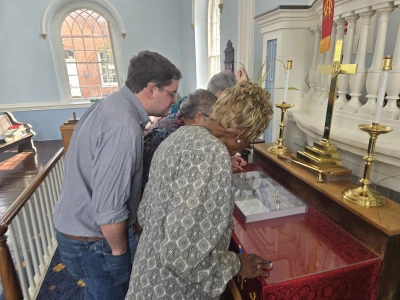 On this year's Pilgrimage, a group of approximately 25 pilgrims began in Baltimore at Old Otterbein UMC. There, they received an overview of pilgrimage from Director of Museums & Pilgrimage, Rev. Bonnie McCubbin. Shannon Katz-Dean, Archives Administrator, then gave a lecture on who Bishop Otterbein was and why Baltimore became a hotbed for German immigration. The group was honored to be the first to see the artifacts from the 2023 excavation of the site, and were particularly excited by the key, pencils, and marbles. Afterward, Archives staff and church members gave a tour of the site.
Following lunch, the group boarded a bus and headed to Salem UMC in Keedysville, Maryland. Salem is one of the oldest United Brethren Congregations still in existence. It began its life as Mt. Hebron and changed its name when it moved toward the town center as the population shifted. Clayton Waring, a layperson and church historian, gave a lecture on George Adam Geeting, an early schoolteacher and preacher for the United Brethren. Geeting opened his school and home to Bishop Otterbein for preaching and also built an early United Brethren Church.
After boarding a mini-bus loaned from Calvary UMC in Frederick, the group was able to set out on country roads that have not changed much in the last 250 years. The still unpaved, narrow, and stone-lined streets led the group to Mt. Hebron Cemetery where early United Brethren leaders are buried.
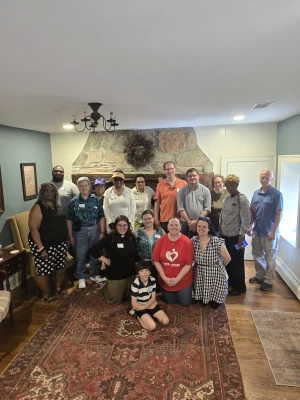
On the way back to the church, the pilgrims were provided a rare opportunity to tour the inside and outside of the Geeting Home, which is still standing and fully renovated. Owned by the Warings, lay members of Salem UMC, it is a place of deep history and faith.
Rev. Rob Lee, Connectional Coordinator for the General Commission on Archives and History, said, “The work of the Commission on Archives and History has to be 'on the ground,' meaning that the general agency has to be present for the moments of the larger denominational church and individual congregations. I was drawn to participating in the entirety of the weekend because it allowed for me to learn about a pillar of United Methodist history I wasn’t fully acquainted with. The pilgrimage gave space for us to compare notes on the ways that varied and disparate traditions came together to give us the gift of The United Methodist Church. After all, Bishop Otterbein is where we get the “United” in The United Methodist Church.”
The next day the celebration continued in worship, where the scripture of the day was Hebrews 2:14-15, the text of the only extant sermon from Bishop Otterbein, as he burned nearly all of his papers before his death. Bishop Otterbein said, “If there is no Christ in us, there is no Christ for us,” and the sermon focused on the role of the incarnation of Christ. All hymns could be found in the last EUB hymnal, and the liturgy also came from EUB resources.
Worship participants received greetings from numerous people, including Rev. Rob Lee from the General Commission on Archives and History and Rev. Emora Brannan, Conference Historian. Former pastors, seminarians, and other clergy also participated. Rev. John Lebo, one of only a handful of clergy ordained in the EUB left, was an honored guest. He said, “This is just wonderful! I’m so glad to be here and that I was invited!”
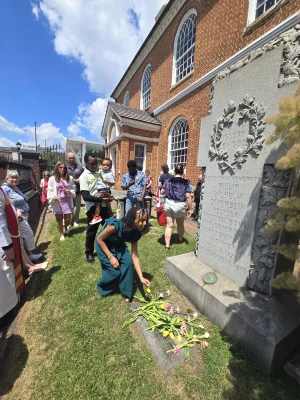 At the conclusion of the service, the congregation processed to the grave of Bishop Otterbein to lay flowers and pray, as is their custom on “Otterbein Sunday,” celebrated the 1st Sunday of June each year. The congregation then gathered for a German-inspired lunch of pork and sauerkraut.
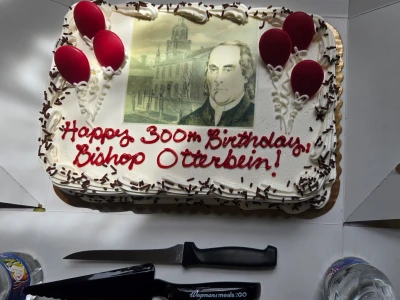
On both days, “Happy Birthday” was sung and a cake shared among those gathered.
Angela Pupino, a Wesley Seminary Student and incoming pastor of Alberta Gary Memorial UMC in Columbia, Maryland, was present and said, “I grew up in a formerly EUB church, so Otterbein's influence was always there whether I knew it or not. But I also believe that Otterbein has a pastoral legacy that continues today. His willingness to work with and learn from Mennonites and Methodists still informs the ecumenical spirit of The United Methodist Church. And the countless German immigrants and German speakers he ministered to over nearly 40 years in Baltimore helped to make what is now the Baltimore-Washington Conference what it is today.”
This sentiment was echoed by Rev. Rob Lee of GCAH, “The beautiful music from the congregation was wonderful, but one hymn in particular stood out. We sang 'In the Sweet By and By,' a popular hymn but one not housed in The United Methodist Hymnal. As the organ played and the voices joined in unison, I couldn’t help but imagine that mystical fellowship just beyond the Jordan where I imagine Asbury, Wesley, Boehm, and Otterbein are gathered, along with all the sung and unsung heroes of the faith. It was a moment where faith felt palpable, and history had come alive. As the church’s pastor, The Rev. Dr. Bonnie McCubbin lifted the bread on Bishop Otterbein’s paten, it was a connecting point to our past and a roadmap for the future.”
To learn more about Bishop Otterbein, his ministry, and his legacy; or to schedule your own pilgrimage, please contact Old Otterbein UMC or Archives and History for the Baltimore-Washington Conference at .