
BWC Annual Conference Opens with Calls to Love Boldly and Act Faithfully
By Erik Alsgaard
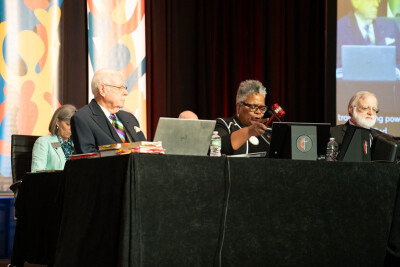 Bishop LaTrelle Easterling gaveled the Baltimore-Washington Annual Conference into its 242nd session on Wednesday afternoon, May 27, as members, distinguished guests, and visitors gathered at the Hilton Hotel in Downtown Baltimore.
After the bishop welcomed the conference, she turned to Richard Church, a member of the BWC’s Committee on Native American Ministries, who welcomed the conference to the land of the Piscataway.
“I greet you not as strangers but as my true sacred relatives,” he said. “You may think of my last name when I say ‘relatives,’ but in my heritage, the circle of kinship is much wider; it is relationship to one another.”
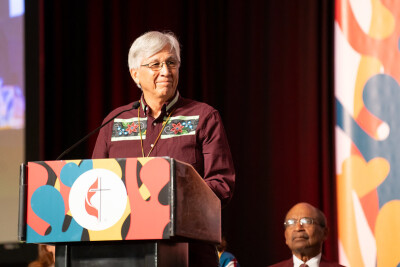 Church noted “relatives” also extends beyond people. “We are all related to this land,” he said. “We are standing today on the ancestral home of the Piscataway people. Earth is not just real estate to be used; the trees, the soil, the waters of the Chesapeake, are all our relative – and we owe them our same respect that we owe our elders.”
Further expanding the definition, Church said that we are all related via our history.
“Our lives are woven together by the stories of those who came before us. In the history of the church of this region, this is shared history. We belong in the stories of one another.”
Echoing the conference theme to “Love Boldly,” taken from Ephesians 3:16-19, Church said in the indigenous way, “there is no love more bold than the love that treats a stranger boldly. I invite you to step out from the isolation of the individual and into the beauty of the whole.”
During a moment of celebration, the Area Committee on the Episcopacy thanked both Bishop Easterling and her husband, the Rev. Marion Easterling, for their faithful service. Rev. Easterling serves as pastor at Locust UMC in Columbia. A gift in honor of Rev. Easterling was given to Seeds of Security in his name.
“It is our privilege, our honor, and our joy to be in ministry with the Baltimore-Washington and Peninsula-Delaware Conference,” Bishop Easterling said. “We have so much work to do, so much justice to achieve. You are amazing servants of God. I am so grateful to be on this journey with this man. He’s a blessing to Locust, to our family, and to me. Thank you for supporting Seeds of Security and for supporting us.”
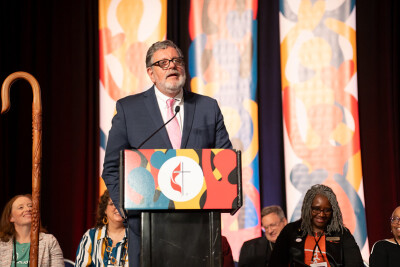 The conference also welcomed the Rev. David McAllister-Wilson, president of Wesley Theological Seminary, who is retiring this year after being at the school for 44 years, including his time as a student. In a moment of personal privilege, he addressed what he sees as the biggest challenge facing the church and society today: Artificial Intelligence.
“It will upend many of our parishioners,” he said. “It is also a fundamental challenge to our faith. That’s because AI appears god-like: it knows everything, appears everywhere, and even lives in a cloud.”
More ominously, he said, “the combination of AI, social media, marketing, and CGI, has the power to spread big, believable lies that strike at the heart of the media and other institutions.”
"And," he said, "it’s tearing apart the fabric of social community. Maybe, the real problem of AI isn’t ‘intelligence’; it's ‘intimacy’.”
This disconnection is something the church can address, he noted, saying that he was reminded of the old hymn that often opens Annual Conference Sessions around the world.
“In this age of AI,” McAllister-Wilson said, “I hear in my head a familiar hymn, but now I hear it with special meaning: ‘And are we yet alive, and see each other’s face?’”
Conference members then began some of the work of the gathering, tackling three separate changes to the conference rules, and two of the other four resolutions.
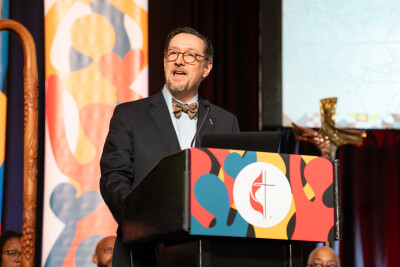 The Rev. Bryant Oskvig, chairperson of the Rules Committee, carefully walked people through the language of the changes. Each of the three passed.
The first change deleted language in Conference Rules about the length of service for the Director of Connectional Ministry. Previously, the person in that ministry had to be re-elected every year, and was limited to an eight-year term. That language was removed.
The second change updated Conference rules on the amount of time candidates for the episcopacy who are nominated from the floor at Annual Conference have to prepare a written statement of their candidacy.
And the last change brought the conference in-line with changes to the 2020/2024 Book of Discipline regarding changes to lay membership in the Annual Conference.
The next resolution to come to the floor dealt with fossil fuels. Submitted by the Baltimore-Washington Creation Care Team, the resolution sought to restrict the BWC’s Council on Finance and Administration, the Board of Trustees, the Board of Pensions, and any related foundations or agencies under its authority, from having companies in their investment portfolios whose “core business activity” (10 percent or more of revenue) from “the extraction, production, or refining of fossil fuels.”
The resolution offered a three-year timeline for achieving this goal.
Speaking against the resolution, Stephen Art, a lay member at Wesley Grove, expressed concerns about the implications of this resolution.
“Limiting investment options,” he said, “by its very nature can impact investments.”
He also noted that the resolution references “widely recognized” fossil fuel industry lists. “This isn’t specific,” he said. “There’s actually a number of different ‘widely recognized’ lists. Without knowing which list, I have concerns.” He ended his comments by saying it was a very flawed resolution.
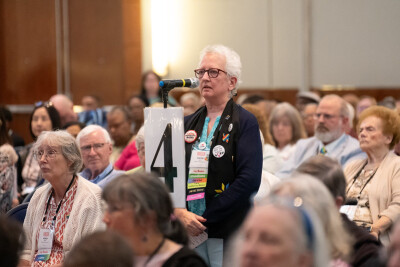 Sherry Koob, a lay member from Middletown UMC and a Creation Care team member, then spoke in favor of the resolution, stating a variation of this motion was presented in 2014 and again in 2015.
“Many Annual Conferences are looking at this,” she said. “Many have already instructed their bodies to divest from fossil fuels. Wespath came up with an alternative fund without fossil fuels in 2016 – I would like to see us totally divest from fossil fuels; that’s something that’s important to me.”
Roger Kuhn, a lay member from Morgan Chapel UMC in Woodbine, spoke against the resolution, saying the underlying analysis of it is problematic.
“While the climate is warming, the climate is not warming at the rate suggested here,” he said. He also said that developing countries need energy and developed countries need to provide it.
“So,” he said, “to help the poorest countries, we need to invest in creating and maintaining a continuous supply of fossil fuel.”
One of the makers of the resolution, Rev. Sharee Wharton, spoke in favor.
“The reason that we brought this resolution forward is because fossil fuels needed to be added to the list of previous restrictions. All we are doing is tooling that language into this resolution so that we are effectively in line with what we’ve already voted: that by 2050, all Annual Conferences will be divested. We thought it was important not to wait 24 years and to do this now. This is the best moral step forward and it’s in the right direction."
The resolution was adopted with just a few voting against it.
The other resolution debated and approved during the session, “Faith in Action,” calls on United Methodists through the Conference to put their baptismal vows in to action. Specifically, the resolution calls for local churches throughout the conference to set aside a portion of “each meeting” to reflect upon the “individual phrases and the overall challenge in our Baptismal Vows.”
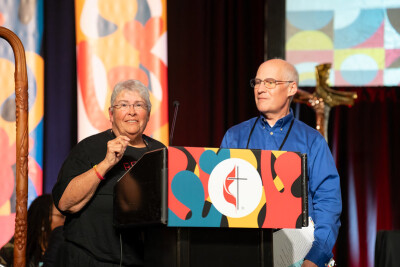 The Rev. Deb Scott, retired, one of the makers of the resolution, said that as United Methodists, “we are called, as children of God, to make a difference in this political climate. Specifically, that we actively resist evil in whatever forms they present themselves.”
During the discussion on the resolution, Stephen Art asked if the resolution intended for every church to do this at every meeting.
“That is the hope,” answered Scott.
However, the Rev. Ken Hawes, pastor at Fairhaven UMC and another presenter of the resolution, said that each church could decide for themselves how to do this. “We take it on faith that churches will do this. There is no metric to check up on this,” he said.
Kuhn – the lay member from Woodbine – offered an amendment to clarify line 216 of the resolution to replace the words “sets aside a portion of each meeting” and replace it with “be encouraged.” That amendment passed, and that paragraph now reads, in part, “…each leadership group within the BWC Annual Conference and each local church be encouraged to reflect upon the individual phrases and the overall challenges of our Baptismal Vows…”
The full resolution, as amended, was adopted.