
Bishop Palmer's Bold Love Bible Study: Vulnerability. Compassion. Justice.
By Alison Burdett
Director of Communications
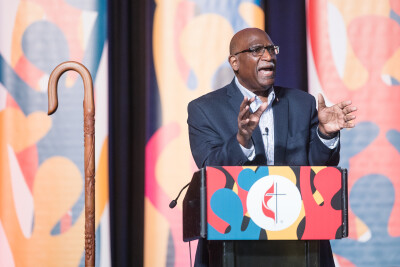 Concluding his two-day Bible study at the Baltimore-Washington Conference, Bishop Gregory Palmer dove deep into what it means to love bodly.
Drawing from the stories of Joseph, the Good Samaritan, and Jesus’ teachings on justice and hospitality, Palmer rooted the morning’s teaching into three words: "I want to give you three words to hold on to, for those of you that need handles. And we all do," he said. "Vulnerability. Compassion. Justice.”
Bold Love Is Vulnerable
Beginning with Joseph’s reunion with his brothers in Genesis, Palmer argued that bold love requires the courage to let down walls and reveal one’s authentic self.
“Bold love is vulnerable,” he said. “Vulnerability is about showing up.”
Quoting researcher Brené Brown, Palmer described vulnerability not as weakness but as the willingness to be seen. Joseph’s transformation came when he could no longer hide behind power, position, or pain. Instead, he revealed himself to the very brothers who had betrayed him.
“Joseph showed up because he let the walls down,” Palmer said.
The bishop then widened the lens to the church itself, suggesting that Christianity’s credibility has often suffered when it became too closely aligned with power and privilege.
“We are being invited to a vulnerability where we show up and actually look like Jesus to a broken and hurting world,” he said.
One of the strongest reactions from the congregation came when Palmer urged the church to abandon the masks and structures that insulate it from real relationships.
“Take off the mask. Disrobe. Dismount. Show up as you,” he said. “You might actually fool around and be a church. I might actually fool around and be a Christian.”
For Palmer, vulnerability is not merely personal. It is a spiritual discipline that allows Christ’s love to become visible in the world.
Bold Love Is Compassionate
Turning to Luke’s account of the Good Samaritan, Palmer explored what it means to love one’s neighbor in practical ways.
“What must I do to inherit eternal life?” Jesus was asked.
Palmer summarized Christ’s answer simply: “Love God. Love your neighbor. Love yourself. And you'll have more life than you can live.”
But he noted that the real challenge comes in answering the next question: “Who is my neighbor?”
The congregation responded enthusiastically when Palmer offered his answer.
 “Err’body,” he said, prompting the audience to shout the word back in unison.
Palmer suggested that many churches become stuck because they fail to wrestle honestly with that question. Rather than focusing inward, congregations must learn to see their communities as the object of God’s love and mission.
The strongest response of the morning came when Palmer connected the neighboring question to contemporary challenges facing the church. Warning against allowing the symbols of the faith to be co-opted by exclusionary ideologies, he urged listeners to reclaim the gospel's message of sacrificial love.
“When you get away from the cross, the Ku Klux Klan takes the cross over,” Palmer declared, drawing immediate applause, as many in the room stood to their feet.
Reflecting on the meaning of Christ's sacrifice, Palmer pushed back against interpretations of Christianity that elevate power, nationalism, or cultural dominance above the teachings of Jesus.
“Don't surrender the cross to these other folk that put it up as a symbol of white Christian nationalism,” he said. “There is not room in the gospel for that viewpoint. It is antithetical to the gospel. Let me see if I can say it a little stronger. It is abhorrent to the gospel, and it is nauseating to the nostrils and the gut of God."
Quoting beloved hymns that celebrate God's redeeming love, Palmer reminded listeners that the cross points not to exclusion but to grace, mercy, and self-giving love. “Love so amazing and so divine demands my life, my soul, my all,” he said.
Using the Good Samaritan as an example, Palmer outlined four actions that characterize compassionate discipleship: “He saw. He stopped. He stooped. He served.”
Compassion begins with paying attention, he explained.
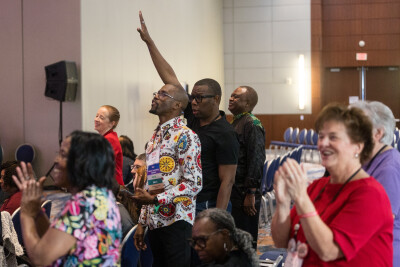 “We need to look at the hurts of the world,” Palmer said. “How are you going to look at somebody starving because of food inequality and turn your head away because it’s too painful for you?”
Palmer contrasted the Samaritan's response with the instinctive human tendency to calculate costs and benefits before helping others. While the priest and Levite appeared focused on what might happen to them if they stopped, Palmer suggested the Samaritan asked a different question.
“I don't know what was going on in his head,” Palmer said, “but I need to believe that it was about the wounded man, and for just a moment, maybe he said, ‘It's not about me. It's about what will happen to him if I don't stop and if I don't help.’”
Recalling the Samaritan's promise to repay the innkeeper for any additional expenses, Palmer offered a word of encouragement for those engaged in ministry and service.
“I just came by to tell you, anything you do for Christ will last,” he said, drawing enthusiastic affirmation from the congregation.
The declaration underscored Palmer's message that bold love always moves toward suffering rather than away from it.
Bold Love Is Just
In the final section of the study, Palmer argued that compassion alone is not enough. Bold love must also pursue justice.
Drawing from Luke 14, where Jesus instructs his followers to invite the poor, disabled, and marginalized to the banquet table, Palmer challenged the church to move beyond acts of charity and address the systems that create inequality.
“Moving to the margins is not just a soup kitchen,” he said. “It is getting at the root of why I have more than I need and others don’t have what they need.”
He urged congregations to engage not only in direct service but also in advocacy, public witness, and efforts to address the causes of poverty, violence, homelessness, and hunger.
“We have what we have because the tables are flipped in the wrong direction,” Palmer said. “Our duty is not to feel guilty about that. Our duty is to pay it forward.”
Another powerful moment came when he reminded listeners that no one succeeds alone.
“Everybody is standing on somebody else’s shoulders,” he said. “You did not get where you are on your own.”
Palmer concluded with a story from a pastor whose church operates a community meal program. True ministry, she told him, will happen not when volunteers simply serve food, but when they sit down and eat with those they are serving.
“Bold love moves toward the margins,” Palmer said, “not just to deliver services, but to build relationships.”
Following the study, Bishop LaTrelle Easterling thanked Palmer for offering teaching that was both intellectually rich and spiritually nourishing.
“Sometimes you find a place that looks unassuming,” Easterling said, “and it’s soul food. It fills you up from the top to the bottom and gives you something to carry with you. That’s the kind of teaching we have gotten over these two days.”
With that, Palmer’s Bible study series concluded, leaving conference members with a clear challenge: to embody a bold love that is vulnerable enough to show up, compassionate enough to stop and serve, and courageous enough to pursue justice wherever God calls them.