
Bishop Palmer's AC Bible Study Calls Church to Live “A Purpose Bigger Than Ourselves”
By Alison Burdett
Director of Communications
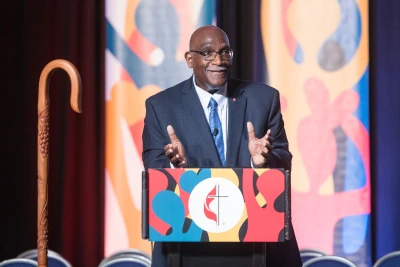 Clergy and laity gathered Thursday morning for the opening session of the annual conference Bible study led by Bishop Gregory Palmer, who invited participants into a deeper understanding of the conference theme of being “rooted and grounded in love.”
Drawing from Ephesians, Bishop Palmer challenged the church to see itself not merely as an institution, but as a living witness to God’s vision for humanity.
Throughout the morning, Palmer returned repeatedly to the image of rootedness found in Ephesians 3:17, encouraging worshippers to become deeply grounded in Christ and interconnected with one another.
“We are being rooted and grounded in love,” he said. “Roots give stability so that we are not blown away. To be rooted in Jesus Christ is to affirm and acknowledge my connectedness not only to Christ, but also to you.”
Palmer framed the book of Ephesians as a call to unity in a fractured world, emphasizing that God’s desire has always been to bring people together across divisions of race, class, tribe, and status.
“God’s mystery, God’s purpose, has always been to have individuals who saw themselves in community with one another,” he said. “God intended that we would live in communities that flourish and pour goodness into the world.”
The bishop spoke candidly about the divisions that continue to shape both society and the church, reminding listeners that Christ has already “broken down the dividing wall of hostility.”
“I wonder if we are overthinking this thing,” Palmer reflected. “The barriers that keep us from one another and from God have already been torn down. Our work is to live more fully into the gift God has already given.”
At the center of the study was Palmer’s assertion that the church is called to embody before the world the kind of community God intends for all creation.
Quoting a phrase that has stayed with him for years, Palmer said, “God asks the church to live before the world what God intends for the whole world.”
He connected that vision to the church’s mission today, describing congregations as “small working models of new creation.”
“Is this local congregation a small working model of God’s new creation?” he asked. “That’s what Ephesians is about.”
Palmer also emphasized that this kind of transformation cannot be accomplished through strategic plans or organizational structures alone.
“This thing will be wrought by prayer,” he said. “If left to our own devices, we will keep doing what we’ve been doing. But with the help of the Holy Spirit, and with the vision of the crucified Christ before us, we are drawn into another way.”
The bishop’s teaching blended theological reflection with humor, storytelling, and personal testimony. He encouraged participants to rediscover the richness of Methodist hymnody, calling the United Methodist Hymnal a resource for developing “a love theology.”
“Everything you need is there,” he said. “It will trace you right back to the Bible.”
Palmer also challenged both clergy and laity to resist possessiveness over the church, reminding listeners that the church ultimately belongs to God.
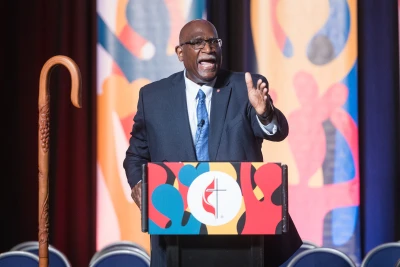 “This is God’s church,” he said emphatically. “Any church Palmer has is not worth having.”
He shared stories from ministry to illustrate the danger of focusing on personal goals rather than God’s larger mission, urging leaders to remember that they are participating in work that extends far beyond themselves.
“If you’ve got a purpose bigger than yourself, you can never finish the job,” Palmer said. “You only get to the end of one sentence, but you’re still in the middle of the paragraph.”
As the study drew to a close, Palmer turned to John 15 and the image of abiding in Christ, describing discipleship as “luxuriating in what God has already provided.”
“Abiding is about getting deep into who the God made known in Jesus Christ is,” he said. “The root system finds its home in the soil.”
Palmer will continue the Bible study Friday morning at 8:30 a.m., where participants are expected to continue exploring the conference’s three-year theme of rootedness, unity, and God’s vision for the church and the world.