
After 2,300 Miles, Venerable Monks Conclude Walk for Peace in Washington D.C.
 By Alison Burdett
The final steps were taken quietly.
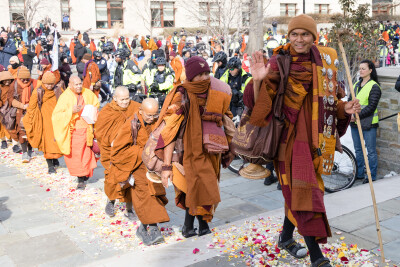
After more than 100 days and 2,300 miles on foot, the Venerable monks of the Dhammacetiya concluded their Walk for Peace in Washington, D.C. On Tuesday, February 10, they arrived first at American University and later at National United Methodist Church, where they took their one meal of the day, before continuing on to Washington National Cathedral.
Their journey began in Fort Worth, Texas, and carried them through 10 states. Bishop Easterling reflected, “Their pilgrimage was neither commodified nor partisan; rather, it emerged from a profound conviction that peace is possible when we commit ourselves to daily mindfulness, presence, and compassion. My heart continues to overflow with gratitude for the privilege of walking alongside them, even briefly.”
At American University, one of the final stops of the pilgrimage, the monks were welcomed in recognition of the university’s long-standing interfaith commitments through the Kay Spiritual Life Center, which has served as a place of prayer and belonging for dozens of faith communities, including United Methodist and the Theravada Buddhist tradition.
During a peace-sharing program at Bender Arena, the Venerable Bhikkhu Paññākāra spoke about mindfulness in a world marked by distraction. Multitasking, he suggested, fragments the spirit and intensifies stress, while wholehearted presence restores calm. He encouraged listeners to pay attention to their breathing.
“The air is free,” he reminded them.
When we focus on our breath, he explained, we become present to this moment and to our bodies. The worries and stresses that cross the mind are transitory.
Reflecting later, Rev. Bryant Oskvig, pastor of National United Methodist Church in Washington D.C., offered a Christian interpretation of the teaching: “When we pay attention to our breathing, we are noticing the wonderful gift that life is, this one moment, and the beautiful grace in even the air we breathe.”
A moment that stuck out in Bishop Easterling’s mind was when Venerable Bhikkhu Paññākāra spoke with gentle wisdom about our tendency to cling to yesterday or grasp for tomorrow, calling such striving “trash” because it robs today of its sacredness. “His words were a summons to reverence the present moment as holy ground,” Bishop Easterling said.
From American University, the monks walked the final stretch to National United Methodist Church. Snow-lined streets and increased traffic from those hoping to witness the pilgrimage slowed movement throughout the city. A mile-and-a-half Uber ride stretched into 40 minutes of traffic. Yet the contrast between sitting warm and sheltered from the steep and icy sidewalks and the monks’ 2,300 miles walked through rain and winter weather shifted the moment from inconvenience to gratitude.
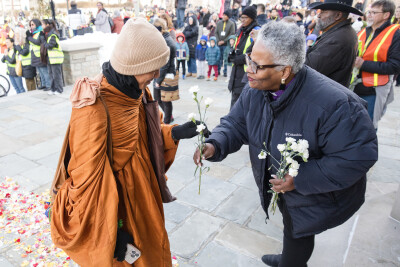
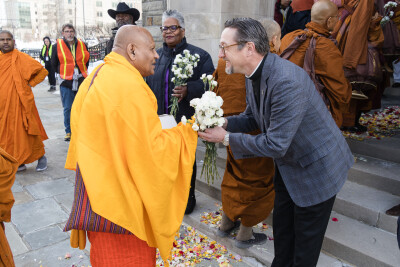 Hundreds of members of the community made the trek out to gather on the church’s front plaza as Bishop LaTrelle Easterling and Rev. Oskvig greeted each monk individually, offering flowers and words of peace before they entered the sanctuary.
“Rarely do we encounter individuals so wholly committed, both selflessly and sacrificially, to such a disciplined practice,” Bishop Easterling said. “Their pilgrimage emerged from a profound conviction that peace is possible when we commit ourselves to daily mindfulness, presence, and compassion.”
For Rev. Oskvig, the welcome was both symbolic and practical.
“By sharing our space, we make a tangible witness to the hospitality we claim,” he said. “In being present to this moment of their prayer journey, we find common expression for the deep desire for peace and compassion throughout our world.”
Inside, an estimated 300 Buddhist leaders and laypersons joined the monks in receiving their sole meal of the day in silence.
Unexpectedly, Rev. Oskvig was invited to join Venerable Bhikkhu Paññākāra for the meal.
“It was an unexpected and incredible honor,” he said. Before eating, the two shared a quiet conversation about the journey. The monk spoke of early challenges, struggling at first to find places to sleep, and of the surprise of growing crowds as churches opened their doors in hospitality. “He said he never imagined the walk would receive this much attention.”
The silence of the meal itself left an impression.
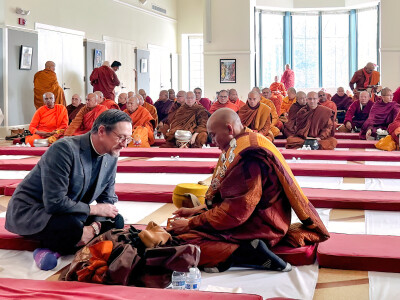 “With no conversation, my attention was on the gift of the food, its flavors, its textures,” Rev. Oskvig said. “I was very aware of the experience of eating itself.” Though he joked that he still prefers “the raucous joy of fellowship at a Methodist table,” he marveled at the sacredness of the moment.
Shortly before noon, following their silent meal, the monks departed National UMC and continued on foot toward Washington National Cathedral for an interfaith gathering. During that gathering, The United Methodist Church was humbled to be thanked for its hospitality, as a Buddhist monk quoted Hebrews. Continuing, "A sanctuary is not opened by one person alone; it opens only when the whole community shares the same generosity."
The conclusion of the Walk for Peace in the nation’s capital marked the end of a physical journey, but not the end of its invitation. Peace, the monks demonstrated, is not only something to advocate for. It is something to practice step by step, breath by breath.