"We Hold These Truths": Bishop Easterling joins national interfaith service marking America's 250th anniversary
By Alison Burdett
Director of Communications
"We hold these truths to be self-evident, that all men are created equal..."
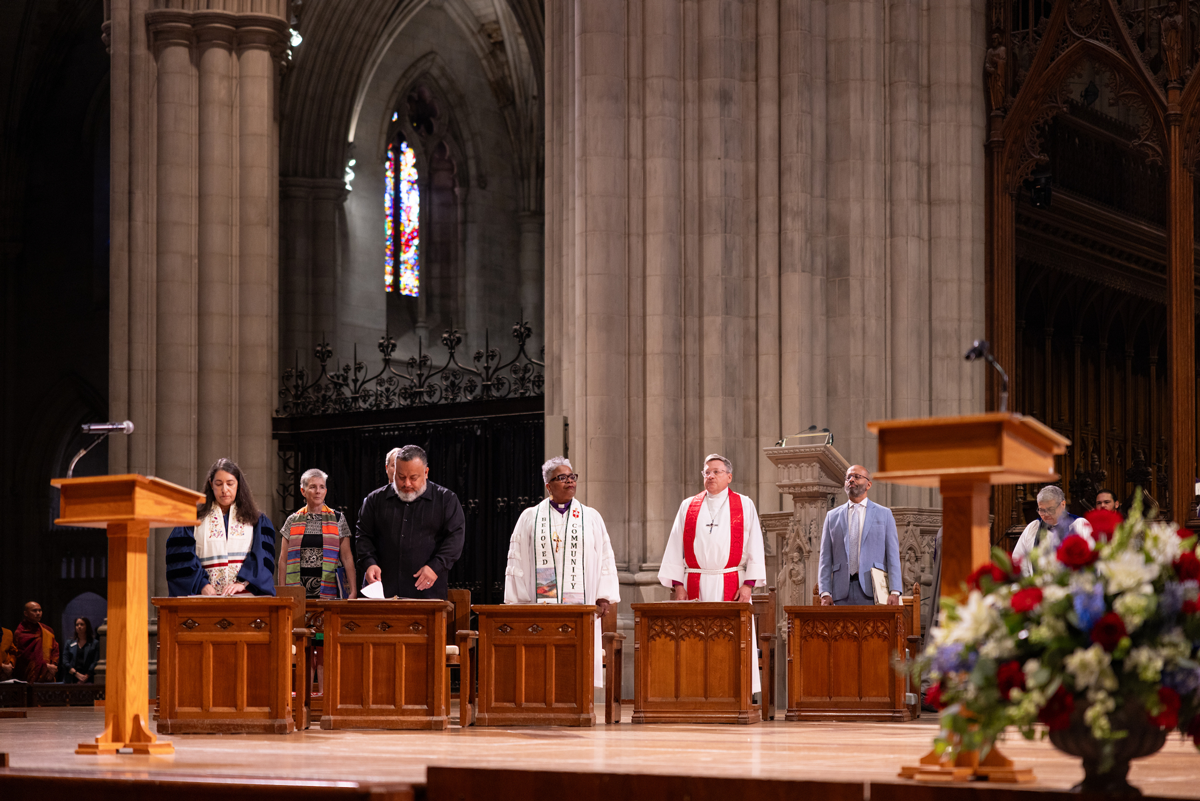
Those familiar words from the Declaration of Independence echoed through Washington National Cathedral on July 3 to a full congregation, as well as to more than 2,200 people who joined online for We Hold These Truths to Be Self-Evident, an interfaith service commemorating the 250th anniversary of the United States.
But rather than offering a simple patriotic celebration, the two-hour service invited worshippers into something deeper: a remembrance that held together both America's founding principles and the painful realities that have too often stood in contrast to them, while pointing toward hope for the future.
Hosted by Washington National Cathedral, the service wove together Scripture, music, historical readings, and reflections from Christian, Jewish, Muslim, Buddhist, Sikh, Hindu, Latter-day Saint, Mennonite, and Native American traditions. Throughout the morning, these voices reminded those gathered that the nation's story remains unfinished.
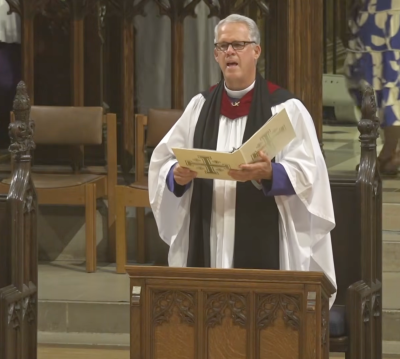 Dean Rev. Randolph Marshall Hollerith set the tone in his welcome, describing the gathering as an opportunity "to celebrate 250 years of the American experiment... but also, to be honest about the promises of this nation that are still unfulfilled," adding that "the American experiment is an ongoing project and that all of us together have work to do."
The service acknowledged that work from its opening moments with a land acknowledgment honoring Indigenous peoples and remembering the enslaved people who labored on the Cathedral grounds before the property was acquired. Native American drums and flute accompanied the solemn procession before Joshua Shumak, vice chief of the Wassamasaw Tribe of Varnertown Indians, offered the Great Spirit Prayer.
Historical readings then traced America's long pursuit of freedom and justice. Passages from Abigail Adams, Frederick Douglass, Abraham Lincoln, Susie King Taylor, Franklin D. Roosevelt, Martin Luther King Jr., Lyndon B. Johnson, and Justice Anthony Kennedy were interwoven with hymns and prayers, revealing both the nation's aspirations and the many times those aspirations fell short.
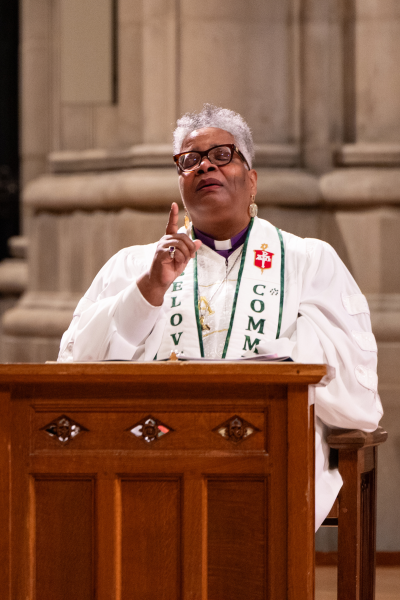
Representing The United Methodist Church, Bishop LaTrelle Easterling of the Baltimore-Washington and Peninsula-Delaware Area offered the service's Prayer for Freedom while wearing an episcopal stole reflecting the Area's commitment to Building Beloved Community. Standing amid readings from Frederick Douglass, Lincoln's Gettysburg Address, and Susie King Taylor's Civil War memoir, Easterling acknowledged the difficult truths of the nation's history while refusing to leave the congregation without hope.
"Source of Truth and Righteousness," she prayed, "we look squarely at the heavy truths of our history and the deep contradictions of our past. We honor the prophetic courage of those who laid bare our national and moral failings, and the resilient heroes whose sacrifices are too often forgotten. Forgive the times our celebrations and prayers have been an empty promise to those denied safety and justice. Do not let the lives given for freedom be in vain. Turn our eyes to the unfinished work before us. Bind us together as one human family, revive our spirits with a stubborn hope, and grant us the fierce determination to bring about a new birth of freedom for all people."
Immediately afterward, the Cathedral Choir filled the sanctuary with Battle Hymn of the Republic, proclaiming, "His truth is marching on."
The service repeatedly returned to the tension between America's founding ideals and its lived reality. Readings recalled slavery, the forced incarceration of Japanese Americans during World War II, the struggle for women's suffrage, the Civil Rights Movement, immigration, refugee ministries, and the ongoing work of building communities where every person is treated with dignity.
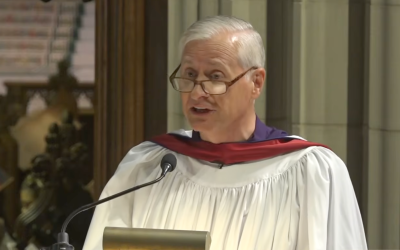 Canon Historian Jon Meacham of Washington National Cathedral offered one of the morning's central reflections. Acknowledging both triumphs and failures, he rejected the notion that America is either perfect or beyond redemption.
"I see a nation that cannot be perfect," Meacham said, "but can surely become at least marginally more perfect. I see a nation that offers grounds for hope even amid suffocating fear." He reminded worshippers that "the function of remembrance is not to muse about what is past, but to arm ourselves for what must be done now."
That same hope carried into the closing Litany of Hope and Unity, where leaders from multiple faith traditions prayed for justice, compassion, and peace. After each petition, the congregation responded together: "Bind us as one, and renew our hope."
Dean Hollerith concluded the litany by praying that God would "bind us so tightly as one human family that the suffering of one becomes the concern of all."
As the service concluded and the Washington Ringing Society prepared to attempt a full peal of the Cathedral bells in honor of the nation's 250th anniversary, those gathered departed with a vision that looked beyond celebration alone. The service suggested that America's next chapter will be written not simply by remembering its founding ideals, but by continuing the work of living them together, with honesty, courage, and hope.