
The Prophet, the Poet and the Fool: Rev. Joseph Yoo Challenges Preachers to Rethink the Pulpit
By Rev. Chelsea Spyers
Asbury UMC, Salisbury, MD
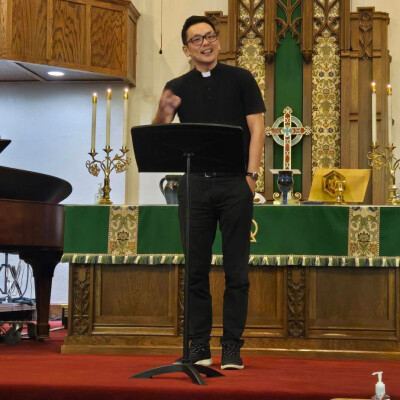 Rev. Joseph Yoo—Episcopal priest, writer, and self-described "professional overthinker trying to live the Gospel one interruption at a time"—was the featured speaker for the 20th Dunkle-Mackey Preaching Seminar in the Peninsula-Delaware Conference. For decades, this seminar has brought a diverse array of voices to our conference, but this year felt uniquely tailored to our current cultural moment. Throughout an afternoon of teaching and an inspiring evening worship service, Yoo brought an infectious energy and a disarming humor, modeling what it looks like to be authentically yourself while fully trusting God’s call on your life.
Checking Our Biases
Yoo kicked off the seminar by examining the baggage we bring to Scripture. He reminded us that preachers aren't the only ones carrying assumptions; our congregations do too, often deciding who the "good guys" and "bad guys" are before a text is even read aloud.
To break this autopilot mode, Yoo invited leaders to say "I don’t know" a bit more often and ask four weekly questions to stay conscious of their homiletical choices:
- What does the passage actually say?
- What do I take away from it on a first reading?
- What biases am I bringing into the text?
- Whose perspective might change how I see this passage?
"We owe it to our people to continue to keep asking questions," Yoo noted.
Three Ways to Tell the Story
Moving from study to pulpit, Yoo emphasized that because stories have the power to connect us to Jesus—the ultimate storyteller—preachers must understand the narrative forms they use. He offered up three archetypes:
- The Prophet’s stories challenge us. These are the sermons that call direct attention to current realities and fiercely challenge the status quo. The Prophet pays close attention to whose suffering has become normalized by society, reminding the church that all creation bears the image of God and deserves systemic care, respect, and equity. The Prophet demands justice and the dismantling of broken systems.
- The Poet’s stories comfort us. The Poet gives words to the heavy, unspoken burdens that people carry into the pews each Sunday, helping the isolated feel less alone. Instead of raging against what is, the Poet speaks of what might be or what could be. They heal wounds by helping the congregation imagine a kingdom world that looks entirely different from our current reality.
- The Fool’s stories entertain us. The Fool utilizes humor to tell the dangerous truths that others wouldn't dare utter out loud. By making the audience laugh, the Fool disarms the room and gently exposes our absurd assumptions or hypocrisies. Through this laughter, people are opened up to see their own flaws before their defenses can go up, paving the way for genuine transformation.
A good preacher must fluidly use all three roles, discerning when to lean in which direction. Relying on just one can cause a preacher to get stuck and their audience to stop paying attention. Rev. Yoo asked us which role we tend to lean on, which one makes us uncomfortable, and what it might look like to lean there a little more.
The Cost of Courage
Finally, Yoo reminded us that preaching truth to the institutional church takes immense grit. Scripture shows that Jesus is always loyal first to the "least, last, and lost"—a priority that naturally disrupts the status quo that institutions often strain to preserve.
Sharing vulnerable examples from his own career, Yoo noted that the most courageous path is rarely the most popular, nor does it always lead to conventional "success." When holy disruption causes inevitable friction, Yoo offered this brilliant framing: “Great leadership is disappointing people at a rate they can handle.”
Participants left with a powerful reminder: the Word we share won't always make us popular, but if we approach the task with humility and stay radically grounded, God will carry us through—even on the Sundays it feels like we are preaching to an empty room.