
Preaching for Such a Time as This
By Rev. Laura Norvell
Faith UMC, Rockville
On Sunday mornings, pastors climb into pulpits to share the good news of the gospel. We hope people will experience the power of the Triune God and be transformed, day by day. For that to happen, the good news cannot stay in the sanctuary. It must shape how a congregation meets the realities and challenges of the week. This is how we deepen our discipleship and learn to follow Jesus more closely.
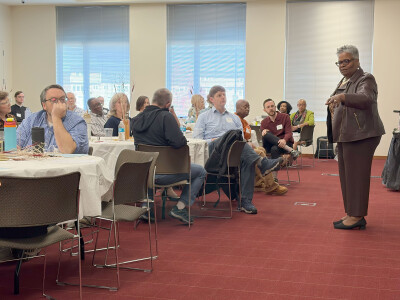 Since September 2025, connecting pastors in the Baltimore-Washington Conference have met monthly with Bishop Easterling for prayer, fellowship, teaching, deep listening and discussion. In October, at the request of several connecting pastors, Bishop Easterling devoted our afternoon to the vital importance of preaching in this time and place. How do we, as theologians and pastors, walk with integrity in this moment in history? What does it mean to preach “for such a time as this”?
This was not a conversation about partisan politics. It was a conversation about how the message of Jesus shapes our engagement with the world, the polis, the public life we share. Jesus and the whole witness of Scripture have much to say about how power is distributed and exercised and how human communities are organized. The law returns again and again to the orphan, the widow and the alien in the land. The prophets confronted kings over the treatment of the poor. Mary sang of the powerful brought down and the lowly lifted up. Jesus announced good news to the poor and release to the captives and told us we would meet him in the hungry, the stranger and the prisoner. To preach these texts faithfully is to preach about the shape of our common life.
Citing the longing of the young people participating in the Council of Bishops' Leadership Gathering in Calgary in October, Bishop Easterling named a hunger for more prophetic preaching, teaching and writing. That has been my experience in the local congregation. During the pandemic, we faced hard realities about who was at greatest risk, who had access to healthcare, and whose household economies were most disrupted. At Faith UMC, we began exploring more and more justice issues through the lens of Scripture.
As the people of Faith UMC learned more about the politics of Jesus and his orientation toward justice, it began to change them. It changed how they served, shared their time and money, and even showed up on Sunday morning. New people came to our congregation hungry for a word that does not simply comfort them on Sunday, but one they can live into throughout the week. Long-standing members are experiencing growth and transformation too.
We cannot compartmentalize our faith and grow as disciples. A gospel that reaches only the private corners of our lives leaves the rest of the week, our work, our spending, our neighbors, untouched by grace.
This is our inheritance as United Methodists. John Wesley insisted there is no holiness but social holiness. Methodism has never been rooted only in personal piety. The early Methodists prayed, fasted and searched the Scriptures, and they also visited prisons, fed the hungry, taught the poor and opposed the slave trade. Works of piety and works of mercy belong together. Preaching that connects faith to the social concerns of the moment is not a departure from our tradition; it is a recovery of it.
Preaching rooted in Jesus’ teaching and engaged with the real concerns of our day also opens a door to repentance. The church has not always stood on the side of the Gospel. Bishop Easterling noted that manifest destiny and the Doctrine of Discovery were preached from pulpits and used to justify taking land and destroying peoples. Faithful preaching today lets us name those errors, reteach what the church got wrong, and reframe who we understand our neighbor to be.
Bishop Easterling’s teaching left me both challenged and encouraged. Challenged, because preaching for such a time as this requires courage, careful study and deep love for congregations that hold a wide range of views and lived experience. Encouraged, because I have already seen what happens when a congregation is invited to bring the whole of its life under the lordship of Christ. People grow. Communities change. The good news becomes good news for the world. That is the preaching this moment calls for, and it is the preaching our people are hungry to hear.