
D.C.’s oldest African American congregation celebrates 210 years of ministry
By Alison Burdett
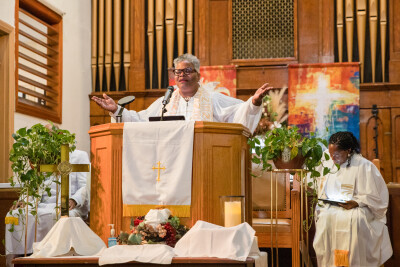 For 210 years, Mt. Zion United Methodist Church in Washington, D.C., has stood as a testament to the faith and perseverance of generations who believed God was calling them to something greater.
On October 11, the historic Georgetown congregation celebrated its anniversary with music, reflections and a stirring sermon from Bishop LaTrelle Miller Easterling, who challenged worshippers to honor their ancestors and demonstrate their same kind of courage in the world today.
The Rev. Dr. Johnsie Cogman, a former Mt. Zion pastor and current Two Rivers district superintendent, highlighted the current her-storic leadership of African American women serving the congregation: Rev. Selena Johnson as pastor, Rev. Ianther Mills as District Superintendent and its episcopal leader, Bishop LaTrelle Miller Easterling.
The celebration's scripture reading, Habakkuk 2:1-3, was read by Rev. Gerald Elston, Sr. pastor of Jerusalem-Mt. Pleasant UMC in Rockville, and son of Mt. Zion UMC. The theme of the service, drawing from verse 2: “Write the vision. Make it plain.”
Founded in 1816 by 125 free and enslaved Black people who left Montgomery Street church to establish their own place of worship, Mt. Zion is recognized as Washington's oldest African American congregation.
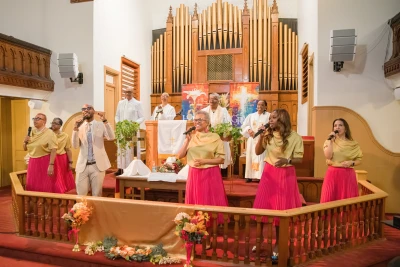 Its legacy came alive through music from the Voices of Zion and reflections from longtime members Sharelle Stagg and Vernon Ricks Jr.
“It's not just history that keeps you in a place,” Stagg said. “It's the sense of belonging and the strength of relationships.”
Ricks reflected on generations of mentors who shaped his life, from Sunday school and camping ministries to music and community involvement.
Before preaching, Easterling prayed, “May the words of my mouth and the meditation of our hearts be acceptable in thy sight, O God, our rock and our redeemer. Speak, God, for your servant and your people are listening.”
Her sermon, “Trusting God in Trying Times,” drew parallels between the prophet Habakkuk's questions about injustice and the challenges confronting the church today.
Easterling asked the congregation to imagine the audacity of Mt. Zion's founders, who established a church in 1816 despite living under the constant threat of being chained, whipped or killed. Even as their own freedom was denied or threatened, they declared their faith in God and built a church for a future they could not be certain they would live to see.
“We do not honor the saints who came before us by merely recounting their faithfulness,” she said. “We honor them by asking whether we are prepared to exercise the same courage in the circumstances before us.”
Like Habakkuk, who cried, “How long, O Lord?” amid injustice and exploitation, Easterling urged the congregation to confront suffering rather than remain silent.
“Faith is not the absence of questions,” she declared. “Faith is the courage to bring our questions into the court of God.”
Then, departing from her prepared sermon, Easterling addressed the possibility of a televised execution, warning against participation.
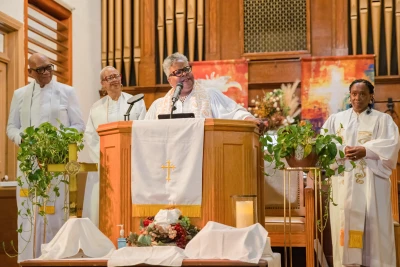 “If, in fact, in these United States of America, the execution of a human being is televised, do NOT criticize the moral depravity of the one doing it if you are going to watch it,” she said.
“Are we going to participate in the insanity? Are we going to participate in the depravity? Are we going to participate in the godlessness?” she asked.
Easterling also condemned the rise of Christian nationalism, which she criticized for reducing the faith of Jesus Christ to a political instrument stripped of its commitment to radical love, mercy and justice.
“In such a time as this, the church cannot afford to be naive. We cannot afford to be silent, neither can we afford to surrender to despair,” she declared.
For the church, confronting injustice requires both the courage to speak truth and the willingness to act.
“I want us to pray,” she said, “but then we have to put feet to our prayers and be willing to go out and confront the injustice that caused what we were praying about.”
Returning to Habakkuk's instruction to write the vision plainly, Easterling asked, “Who will be a herald for God today?”
“We need a vision rooted in Jesus Christ, whose love crosses boundaries, whose mercy restores the excluded, whose truth confronts hypocrisy,” she said.
That vision, she suggested, could take practical form through teaching children their history, affirming their dignity and bringing the church's witness into the surrounding community.
Invoking the African concept of Sankofa, Easterling urged the congregation to carry forward the best of its past while embracing God's unfolding future.
As her sermon concluded, the congregation rose to its feet in affirmation. Amid the response, Easterling looked heavenward and repeatedly mouthed, “Thank you, God.”
The quiet moment seemed to bring her opening prayer full circle. Her quiet expression of gratitude offered a glimpse of what many in the church would recognize as the movement of the Holy Spirit.
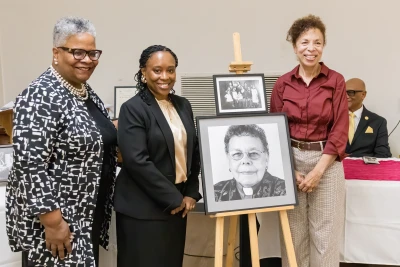
Following worship, Mt. Zion celebrated two women whose leadership extended far beyond Georgetown.
The congregation unveiled a portrait of Bishop Leontine Turpeau Current Kelly, born in the church's parsonage while her father, the Rev. David DeWitt Turpeau, served as pastor. In 1984, Kelly became the first African American woman elected bishop in The United Methodist Church. One of her descendants attended the unveiling.
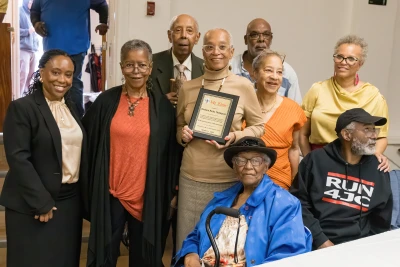 The family of Barbara Ricks Thompson also received a special plaque, whose faith and leadership were nurtured at Mt. Zion. Thompson served as general secretary of the United Methodist General Commission on Religion and Race from 1985 to 1998, championing racial justice and cross-cultural ministry throughout the denomination.
As Mt. Zion looks toward its next 210 years of ministry, the congregation invites others to help preserve its historic sanctuary, ensuring that the sacred space built by generations of faithful believers continues to welcome and serve generations yet to come.