World Communion celebration honors Rev. Yolanda Pupo Ortiz’s ministry of welcome
 By Alison Burdett
Director of Communications
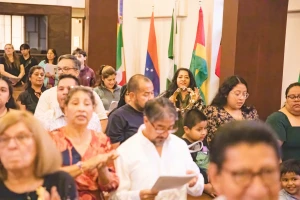
With tambourine and maracas, clapping and dancing, worshippers at Epworth UMC in Gaithersburg celebrated World Communion Sunday in two languages and honored a pastor whose ministry has helped generations find their place in the church.
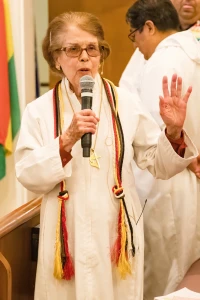 The October 4 service brought together the Baltimore-Washington & Peninsula-Delaware Area Hispanic-Latine Ministry Committee for a celebration honoring the gifts, leadership and ministry of the Rev. Yolanda Pupo Ortiz. Throughout the evening, English and Spanish carried prayers, songs and expressions of gratitude for a woman known simply as “La Pastora.”
Bishop Minerva Carcaño preached, with the Rev. Giovanni Arroyo providing English interpretation. Bishop LaTrelle Miller Easterling joined Pupo Ortiz and youth lay member Samantha Villegas in presiding at the Communion table.
For Carcaño, the gathering offered a powerful experience of belonging after years of ministry in which she had often felt alone as a brown woman. Addressing the worshippers gathered at Epworth, she said, “To see you singing together both in English and in Spanish, it warms my heart. It feels like the Kingdom of God.” She added, “We can feel together the presence of the Holy,” and encouraged them, “You are on the right track. Please continue to lead us forth.”
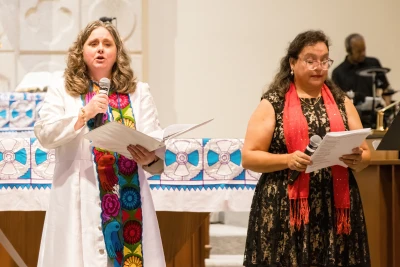 The service’s themes of welcome and community began with a call to worship written by Pupo Ortiz and led by the Rev. Jennifer Fenner and Marcela Uberhuaga of Epworth’s pastoral team. In alternating languages, the call to worship described people approaching God’s table with different footsteps, voices, accents and stories. That image took physical form later in the service as worshippers carried the Communion elements to the table in procession.
“We walk together toward the table of life and hope, the table to which our God and Lord invites us,” worshippers responded.
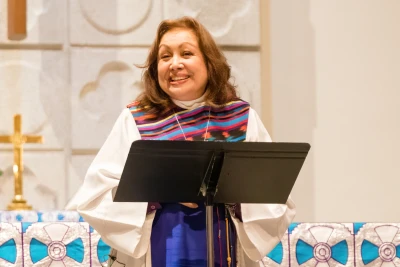
Carcaño’s homily, “La Evolución de una Discípula Excelente,” centered on Luke 10:38–42, the account of Jesus visiting Martha and Mary. She approached the passage with an honest struggle: it seemed to set two sisters against each other, echoing the competition women still face. Through Pupo Ortiz’s witness, a different understanding emerged. Martha’s hospitality and Mary’s determination to learn became expressions of courageous discipleship in a world that restricted women’s lives.
“In Martha and Mary, Jesus saw two disciples with the potential to break unjust laws and break down deeply entrenched social barriers,” Carcaño said, translated from Spanish.
That courage found expression in Pupo Ortiz’s ministry: welcoming people into God’s family, challenging exclusion and making space for those pushed to the margins. The kingdom of God envisioned throughout the sermon was a world where every person matters and those who suffer receive particular care.
Carcaño recalled a recent conversation in which Pupo Ortiz told her, in words translated from Spanish, “We need to resolve the divisions we have created in The United Methodist Church, forgiving each other, recognizing that none of us is a perfect person.”
Reflecting on that conversation, Carcaño continued, “But this sacred work is not done at a distance, in isolation from one another, but in the commitment to approach the other person with vulnerability, sharing our being with them and striving to understand the other person’s thoughts and pain.”
“This requires a change of heart,” she said.
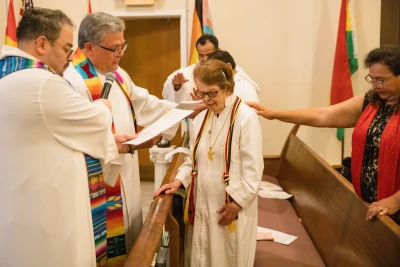 Originally from Cuba, Pupo Ortiz came to the United States with her husband and became the first Latina woman ordained in the New England Conference of The United Methodist Church in 1983. Her ministry has included pastoral leadership, service with the General Commission on Religion and Race, and contributions to Spanish-language worship resources.
During the sermon, tributes from church leaders added testimony to the celebration. Applause greeted the words “es y seguirá siendo nuestra obispa hispana”—“is and will continue to be our Hispanic Emeritus bishop”—an expression of the community’s appreciation for her leadership.
Her contributions were also present in the congregation’s singing of “Heme Aquí,” the Spanish translation of “Here I Am, Lord” that she translated for the official Spanish-language hymnal of The United Methodist Church.
The Rev. Eliezer Valentín Castañón recalled the recognition carried by her familiar title: “When you said ‘La Pastora,’ everyone understood.”
Congregational affirmations accompanied his tribute to the pastor whose influence extended through the conference and its Hispanic ministry.
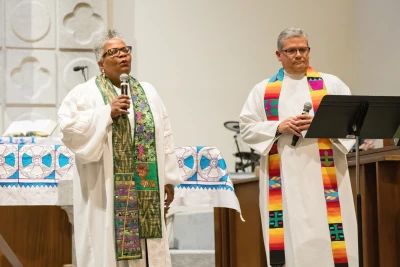 Easterling’s tribute brought the meaning of welcome into deeply personal focus.
“You never know what a welcome will do for a person, or what a lack of welcome does to them,” she said.
Born and raised United Methodist, Easterling joined the African Methodist Episcopal Church after finding herself unwelcome in United Methodist congregations in Colorado. She emphasized that this occurred more than 35 years ago.
Her journey later brought her to Boston University School of Theology and into relationship with Pupo Ortiz, whose welcome and affirmation helped her return to The United Methodist Church. Pupo Ortiz recognized gifts in her that could serve God’s people and spoke life into her ministry.
“You are part of the reason that I stand before the people today back in The United Methodist Church,” Easterling said. “You have no idea how you blessed me and made me feel welcome.”
That influence continued during Easterling’s episcopal leadership. As the Conference confronted white supremacy and the burning of banners intended to intimidate, Pupo Ortiz’s witness and willingness to quietly speak truth to power helped sustain the courage to march, protest and stand.
Applause greeted Easterling’s recognition that Pupo Ortiz’s impact extended beyond the Hispanic community into the African American community and others throughout the denomination.
“We are because you are,” Easterling said. “And I will forever be proud to call you, my pastor.”
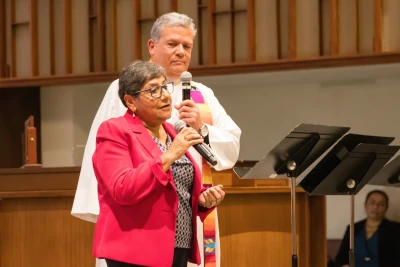 Epworth leader Beatriz Arze offered another personal tribute, with interpretation by Valentín Castañón. Emotion and gratitude accompanied memories of pastoral care through difficult seasons.
A litany of thanksgiving honored ancestors, those who crossed borders carrying hope and faith, and churches that sustained families. The repeated response, “Gracias, Señor,” gave the congregation a shared expression of gratitude.
The celebration also included plans to compile Pupo Ortiz’s calls to worship, prayers and litanies into a worship resource for the wider church.
The shared table brought the meaning of World Communion Sunday into focus. Across English and Spanish, worshippers joined in one liturgy and received one holy meal, giving tangible expression to the unity and belonging celebrated throughout the service.
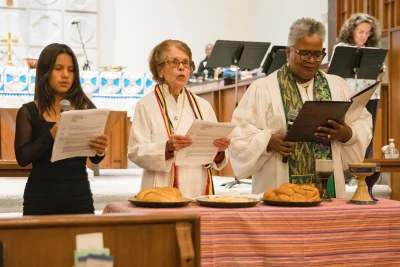 At Communion, the words of invitation reflected the same care honored throughout the evening: “Christ our Lord invites to his table those who are weary and distressed, those who feel alone amid the great crowd that seems to run aimlessly, those who have been wounded in the depths of their souls.”
Children received Communion first. The offering supported UMCOR’s earthquake response, extending the missional response beyond the sanctuary.
The evening concluded with an invitation to dinner, music and folkloric dance.
In the benediction, Easterling carried the evening’s gratitude into a call to action. “May we leave this table determined to make room for others,” she said, “to hold someone else’s hand, to welcome the stranger, honoring every story, bringing hope and healing and embodying a love that knows no borders. We are many people, but one table, many stories, one family, many gifts, one Spirit.”